Fuel Costs — How to Estimate Trip Expenses and Compare Vehicles
What It Solves
Fuel cost estimation seems easy — distance divided by MPG times price per gallon. But the details matter. The calculator includes extra variables that change the answer: the number of passengers for cost splitting, the type of driving (city versus highway MPG differs), and a CO2 emissions estimate that gives you the environmental footprint of the trip. It also includes a vehicle comparison mode that lets you compare two vehicles side by side on the same trip to see which is cheaper to drive and which emits less.
The Real Problem
The real problem is that most people underestimate their fuel costs because they use city MPG for highway trips or use the EPA combined estimate, which rarely matches real-world driving. A vehicle rated at 25 MPG combined might get 22 MPG in winter, 28 MPG on a summer highway trip, and 18 MPG in stop-and-go traffic. The difference between 22 and 28 MPG on a 500-mile trip is about at current prices — not huge for one trip, but over a year of commuting it adds up. Additionally, when road-tripping with friends, splitting fuel costs fairly requires knowing the exact cost rather than guessing. The calculator handles all these scenarios by letting you adjust the MPG, fuel price, and trip distance independently.
How to Use It
Enter the distance of your trip, your vehicle's fuel efficiency in MPG, and the current price per gallon. Optionally enter the number of passengers to see the cost per person. The calculator returns the total fuel cost, cost per passenger, gallons consumed, and estimated CO2 emissions in pounds. For the vehicle comparison mode, enter the specs of two vehicles and the same trip distance. The results show which is cheaper and by how much, as well as the emissions difference.
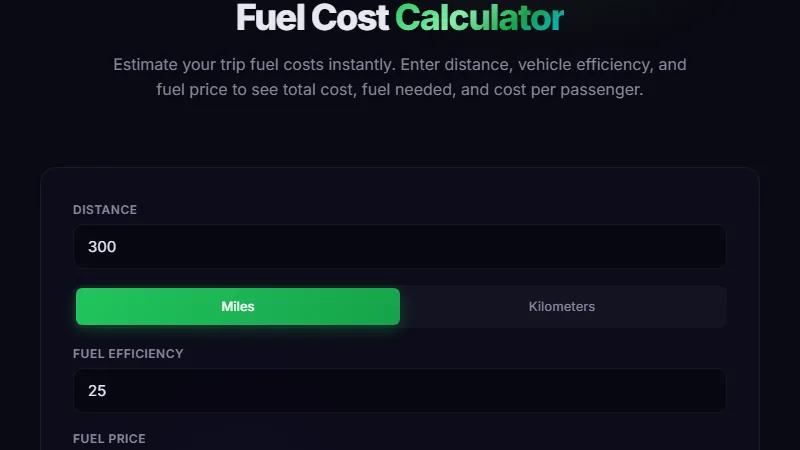
Walkthrough
You are planning a 600-mile road trip. Your car gets 28 MPG on the highway. Gas costs .50 per gallon. The calculator shows you will need 21.4 gallons at a total cost of .00. With three passengers, the cost per person is . The CO2 estimate is about 420 pounds. Now compare with your friend's SUV that gets 18 MPG: total cost .67, emissions 655 pounds. The calculator shows you save .67 and 235 pounds of CO2 by taking your car. That is a concrete number for deciding whose car to take.
Splitting Fuel Costs on Group Trips
When traveling with friends, fuel cost splitting is a common source of friction. The calculator shows the exact cost per person based on the total trip and the number of passengers. If one person drives and the others ride, the driver might not pay for fuel, or everyone splits evenly. The per-person figure gives you a starting number for the discussion. For multi-stop trips where passengers join and leave at different points, the calculator cannot handle that level of detail — but for a straightforward round trip with the same group, it works well. Combine the per-person fuel cost with tolls and other expenses for a complete trip budget.
Comparing Gasoline to Electric Vehicles
The calculator focuses on gasoline vehicles because fuel price and MPG are well-defined. For electric vehicles, the equivalent calculation uses kilowatt-hours per mile and electricity price per kWh. If you drive an EV, a rough conversion is that 1 gallon of gasoline has about 33.7 kWh of energy. Most EVs get 3 to 4 miles per kWh, which is equivalent to 100 to 135 MPGe. At .14 per kWh, an EV costs about .035 per mile, compared to .12 per mile for a 30 MPG gas car at .50 per gallon. The calculator does not directly support EV inputs, but you can approximate by converting your EV efficiency to an MPG equivalent and using that value.
Limitations
The calculator uses a single MPG value for the entire trip. Real-world fuel economy varies with speed, terrain, temperature, load, and driving style. The CO2 estimate uses the EPA average of 19.6 pounds of CO2 per gallon of gasoline burned, which is accurate for the fuel itself but does not include upstream emissions from extraction, refining, and transportation. The calculator does not account for diesel, ethanol blends, or alternative fuels. It assumes the fuel price is constant for the entire trip, which may not hold on long journeys across state lines. The vehicle comparison assumes both vehicles make the same trip under identical conditions, which is rarely true in practice.
FAQ
Should I use city, highway, or combined MPG?
Use the MPG that matches your driving. For a road trip, use highway MPG. For commuting, use city MPG or a realistic blend. The calculator defaults to combined, but you should adjust it based on your route and traffic expectations.
How accurate is the CO2 estimate?
The estimate uses the standard EPA figure of 19.6 pounds of CO2 per gallon of gasoline. This is accurate for the tailpipe emissions. Total lifecycle emissions including production and transport are about 25 to 30 percent higher. Use the figure as a relative comparison between vehicles, not as an absolute environmental impact number.
Can I use the calculator for diesel vehicles?
Yes. Diesel has a slightly different energy density and CO2 factor — approximately 22.4 pounds of CO2 per gallon. Multiply the MPG-based fuel cost by the diesel price per gallon. The CO2 estimate will be slightly low for diesel, but the cost calculation is accurate as long as you use the correct fuel price.
How does cost per passenger help with trip planning?
Cost per passenger makes the expense visible per person, which helps when splitting costs in a group. It also helps compare the efficiency of driving versus flying or taking a train when you divide the total trip cost by passengers.
What if my trip has multiple fuel stops with different prices?
The calculator uses a single fuel price. If you expect fuel prices to vary significantly on your route, use the average price. For a more precise estimate, calculate each leg separately using the local fuel price and sum the results.
Conclusion
Use the calculator before any road trip to budget fuel costs, when deciding which vehicle to drive for a long journey, and when splitting expenses with travel companions. Do not rely on it for precise emissions accounting or for trips with highly variable fuel prices. It is most valuable as a quick comparison tool that turns vague impressions about fuel economy into concrete dollar figures. When combined with the car payment calculator for purchase decisions and the amortization calculator for loan terms, you can model the total cost of vehicle ownership beyond just fuel.
For related transportation and financial planning tools, see the car payment calculator and percentage change calculator for tracking fuel price changes over time.
← Back to Blog