The True Cost of Commuting — How to Calculate What Your Daily Drive Really Costs You
Introduction
Most commuters think they know what their daily drive costs. A gallon of gas here, a toll there, maybe an oil change every few months. But when you actually add up every expense — fuel, maintenance, depreciation, parking, tolls, and the value of the time you spend behind the wheel — most people underestimate their true commute cost by a factor of two to three. That single line item in your monthly budget is probably much larger than you realize, and it is eating into your savings, your retirement contributions, and your free time.
The average American commutes about 16 miles each way and spends roughly an hour per day in the car. Over a 40-year career, that adds up to nearly two full years of time spent commuting and tens of thousands of dollars in direct costs. This article breaks down every component of your commute cost so you can calculate your own number and decide whether the trade-off is worth it.
Fuel Costs
Fuel is the most obvious expense, but even this one is often miscalculated. To find your daily fuel cost, divide your round-trip distance by your vehicle's real-world MPG, then multiply by the price of fuel. Most people use their car's EPA combined rating, but real-world fuel economy is usually 10–20% lower due to traffic, idling, short trips, and weather.
For a 30-mile round trip in a car averaging 25 MPG at $3.50 per gallon, the daily fuel cost is $4.20. Over a 5-day work week that is $21.00. Over a 50-week year (accounting for vacation and holidays), it is $1,050. If your vehicle gets 18 MPG — typical for a pickup or SUV — the same commute costs $5.83 per day, $29.17 per week, and $1,458 per year. The difference between a fuel-efficient sedan and a gas-guzzling SUV is over $400 per year for the same commute.
Maintenance and Wear & Tear
Fuel is only part of the per-mile cost. Every mile you drive wears down your tires, consumes your brakes, depletes your oil, and brings you closer to the next major service interval. The IRS standard mileage rate for 2025 is $0.655 per mile, which accounts for all vehicle operating costs including fuel, maintenance, repairs, tires, insurance, and depreciation. This rate is based on comprehensive studies of vehicle ownership costs and is a reliable way to estimate the total per-mile cost of driving.
Since fuel is already included in that figure, you can separate out maintenance and wear by subtracting your per-mile fuel cost. At $3.50 per gallon and 25 MPG, the fuel portion is $0.14 per mile, leaving about $0.515 per mile for everything else. For a 30-mile round trip, that is $15.45 per day in non-fuel costs — $77.25 per week, $3,862.50 per year. Tire wear alone costs about $0.01–0.02 per mile. Oil changes add another $0.01–0.02 per mile. Depreciation is the biggest hidden cost: a new car loses roughly $0.15–0.25 per mile in value the moment you drive it off the lot and with every mile thereafter.
Parking and Tolls
Parking and tolls are the expenses that sneak up on you because they feel small in the moment but compound relentlessly. If you pay $10 per day for parking near your office, that is $50 per week and $2,500 per year. Even a $3 daily bridge or express lane toll adds $15 per week and $750 per year. Combined, parking and tolls can easily exceed your fuel costs and rival your maintenance expenses.
Many people also pay for parking at their apartment or condo — a monthly fee that exists whether or not they drive to work. While that is a fixed cost rather than a commute-specific variable cost, it is worth considering as part of your total transportation budget. If you can eliminate or reduce these costs by parking farther away, using a park-and-ride, or negotiating a parking allowance with your employer, the savings add up quickly.
The Value of Your Time
This is the category that most people skip, and it is often the largest cost of all. Every minute you spend commuting is time you could spend working, exercising, with family, or pursuing a hobby. The standard way to value commute time is to multiply your hourly wage by the hours you spend driving. If you earn $30 per hour and commute one hour per day, you are effectively losing $30 worth of time every day — $150 per week, $7,500 per year.
Some economists argue that commute time should be valued at 50% of your wage since you might partially enjoy the drive or use it to listen to podcasts. Others say it should be valued at 100% or more because commuting is actively stressful and reduces your quality of life. Even at a conservative 50% rate, that one-hour commute costs $15 per day in lost time value. At 100%, it is $30 per day. Adding time value to the calculation is what makes the true cost of commuting 2–3 times higher than most people expect.
Putting It All Together
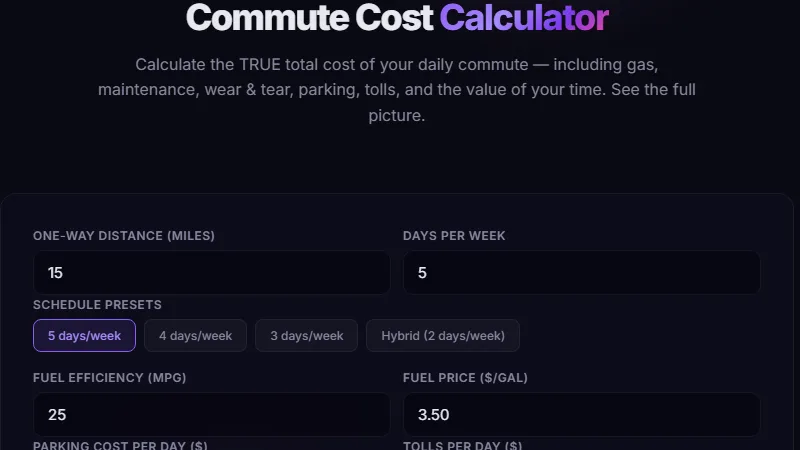
Let's work through a realistic example. Suppose you have a 15-mile one-way commute (30 miles round trip), five days per week, 50 weeks per year. You drive a midsize sedan that gets 25 MPG in mixed driving. Gas costs $3.50 per gallon. You pay $8 per day for parking and $3 per day in tolls. Your hourly wage is $30, and we will value your commute time at 100%.
- Fuel: (30 ÷ 25) × $3.50 = $4.20/day → $21.00/week → $1,050/year
- Maintenance & wear (non-fuel): $0.515 × 30 = $15.45/day → $77.25/week → $3,862.50/year
- Parking & tolls: $8 + $3 = $11.00/day → $55.00/week → $2,750/year
- Time value: 1 hour × $30 = $30.00/day → $150.00/week → $7,500/year
- Total true cost: $60.65/day → $303.25/week → $15,162.50/year
Most people in this scenario would guess their commute costs around $150–200 per month, or about $2,000–2,500 per year. The real number is over $15,000 per year. That is the difference between a modest car payment and a fully loaded luxury SUV every single year. Over 10 years, that same commute costs over $150,000 — a sum that could fund a child's college education, a down payment on a house, or a comfortable retirement supplement.
How to Reduce Commute Costs
Once you see the true number, the natural response is to look for ways to reduce it. Here are the most effective strategies, ranked by potential savings:
- Remote work: Even 1–2 days per week of remote work cuts your commute costs by 20–40%. If your employer allows it, this is the single most impactful change you can make with zero additional expense.
- Carpool: Splitting fuel, parking, and tolls with even one other person cuts those costs in half. With three passengers, your direct costs drop by 75%. Many employers offer preferred parking for carpools or vanpools.
- Public transit: A monthly transit pass typically costs $50–150 — far less than the true cost of driving. Even if the commute takes longer, you can reclaim your time for reading, working, or relaxing.
- Switch to an EV or hybrid: Electric vehicles cost about $0.04–0.06 per mile in electricity versus $0.14–0.20 per mile for gas. Combined with lower maintenance costs (no oil changes, fewer brake replacements), an EV can save $1,000–2,000 per year on a typical commute.
- Relocate closer to work: Cutting your commute from 30 miles to 5 miles reduces your direct costs by 80% and gives you back nearly an hour of time each day. The savings often offset higher housing costs in urban areas.
- Negotiate commute benefits: Some employers offer commuter benefits programs that let you pay for parking and transit with pre-tax dollars, saving 20–30% on those expenses.
Conclusion
The true cost of commuting is almost always higher than you think. When you add up fuel, maintenance, depreciation, parking, tolls, and the value of your time, a seemingly manageable daily drive can become one of the biggest expenses in your budget. The good news is that every dollar you save on commuting goes straight into your pocket — tax-free, with no effort required beyond making different choices.
Use the Commute Cost Calculator to run your own numbers and see exactly what your daily drive is costing you. Once you see the real figure, you can make informed decisions about carpooling, remote work, public transit, or relocation that could save you thousands of dollars per year and give you back hundreds of hours of your life.
For related reading, check out the Fuel Cost Calculator for detailed trip-by-trip fuel estimates and the Car Payment Calculator to see how your commute costs compare to your car payment.
← Back to Blog