Wire Ampacity — How Temperature, Bundling, and Insulation Affect Current Capacity
What It Solves
Ampacity is the maximum current a conductor can carry continuously without exceeding its temperature rating. Every wire has a limit based on its size, material, insulation type, and installation conditions. The wire ampacity calculator applies NEC 310.16 and all applicable derating factors so you know exactly how much current your wire can safely handle in your specific installation.
The Real Problem
The NEC table 310.16 gives base ampacities for conductors at 30 degrees Celsius ambient with no more than three current-carrying conductors in a raceway. Real installations are rarely that ideal. A conduit running through an attic might see ambient temperatures of 45 degrees Celsius or higher in summer. A cable tray with 12 conductors needs derating. Direct burial in hot soil has different thermal properties than free air.
Each derating factor compounds. Start with a 10 AWG THHN conductor, which has a base ampacity of 40A at 90 degrees C (the insulation rating). If the ambient temperature is 40 degrees C instead of 30 degrees C, apply a 0.82 derating factor — down to 32.8A. If there are 6 current-carrying conductors in the conduit, apply 0.80 — down to 26.2A. If the termination points are rated at 75 degrees C (common for standard breakers), the ampacity is limited to the 75 degree column, which is 35A for 10 AWG. The final ampacity is the lowest of all these: 26.2A. That's 66% of the base rating. An electrician who grabs 10 AWG for a 30A circuit in those conditions would be overloading the wire.
The same wire can handle very different currents depending on where and how it's installed. A 4 AWG copper THHN in free air at 30 degrees C is rated for 85A. That same wire in a conduit with 9 other current-carrying conductors in a 45 degree C attic is good for about 85 x 0.70 (temp) x 0.70 (bundling) = 41.7A. The installer needs to know the actual number, not the table value.
How to Use It
Open the wire ampacity calculator. Start by selecting the wire material (copper or aluminum). Choose the wire size from 18 AWG to 1000 kcmil. Select the insulation type — THHN/THWN-2 (90 degrees C), XHHW-2 (90 degrees C), RHW (75 degrees C), or other common types. The calculator shows the base ampacity from the NEC 310.16 table. Then apply correction factors: enter the ambient temperature in degrees Celsius (the tool includes a reference chart: 30 degrees C is the base, 40 degrees C = 0.82 for 90 degree wire, 50 degrees C = 0.71, etc.). Enter the number of current-carrying conductors in the raceway or cable. The tool applies the NEC 310.15(B)(3)(a) adjustment factors. Enter the termination temperature rating (usually 75 degrees C for standard breakers and lugs). The final ampacity is the lowest value considering all derating factors and the termination limit.
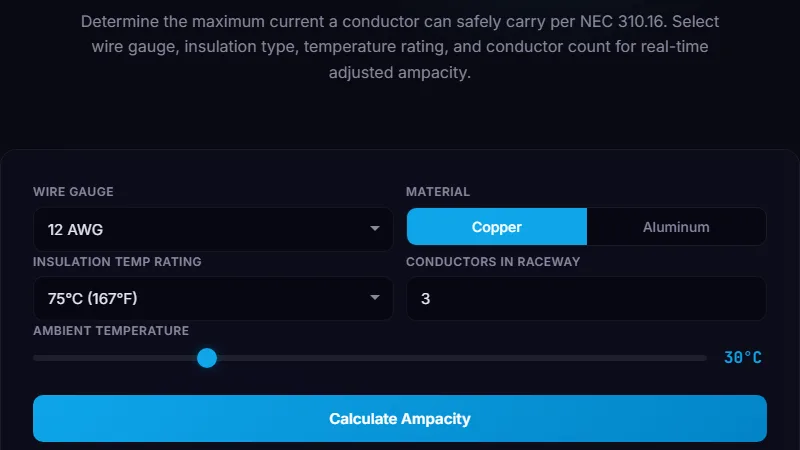
Input: 8 AWG, copper, THHN-90, ambient 40 degrees C, 4 conductors, 75 degree C termination.
Output: Base (90 degree C): 55A. Temp derating (0.82): 45.1A. Bundling (0.80): 36.1A. 75 degree C limit: 50A. Final ampacity: 36.1A.
This means an 8 AWG wire on a 40A breaker in these conditions is technically overloaded. Bump to 6 AWG or reduce the ambient temperature.
Running Wire Through a Hot Attic
A contractor is wiring a new HVAC unit through an attic that reaches 55 degrees C in summer. He plans to use 6 AWG THHN copper on a 50A breaker. Base ampacity of 6 AWG THHN at 90 degrees C is 75A. At 55 degrees C ambient, the correction factor for 90 degree C wire is 0.61. Derated: 75 x 0.61 = 45.8A. That's below 50A. Even though the 75 degree C column says 6 AWG is good for 65A, the attic temperature drops it below the breaker rating. He needs to upsize to 4 AWG (base 95A, derated 95 x 0.61 = 58.0A) or find a cooler path for the conduit. The calculator catches this before the wire is pulled and the inspection fails.
Derating for a High-Density Cable Tray
An industrial panel has 15 current-carrying 12 AWG THHN conductors in a single cable tray. The NEC bundling adjustment for 10-20 conductors is 50%. Base ampacity of 12 AWG THHN: 30A. After derating: 15A. But the 75 degree C termination limit for 12 AWG is 25A. The final ampacity is 15A — meaning each conductor can only carry 15A. The design called for 20A circuits. Each circuit must now be upsized to 10 AWG or the conductors must be split across multiple trays. The calculator shows the penalty immediately, preventing a design that would have overheated in service.
Limitations
The calculator follows NEC 2020 derating rules. Local amendments may differ — some jurisdictions have stricter ambient temperature assumptions or require additional derating for rooftop conduits exposed to direct sunlight (NEC 310.15(B)(3)(c) already addresses this with a +33 degree C adder). The tool also assumes standard installation conditions. For unusual configurations — like conductors in underground ducts with differing soil thermal resistivity, or high-altitude installations above 2000 meters — additional engineering judgment is needed beyond the calculator's scope.
Ampacity is only one constraint. Voltage drop and conduit fill must also be checked for every installation. A wire that passes ampacity might fail voltage drop on a long run, or might not fit in the available conduit. The calculator doesn't check the other constraints — it's one piece of the wire-sizing puzzle.
FAQ
What is the difference between 60, 75, and 90 degree C wire ratings?
These are the maximum operating temperatures of the insulation. Higher temperature ratings allow higher ampacity for the same wire size. However, terminations (breakers, lugs) are typically rated at 60 or 75 degrees C, which limits the wire's ampacity regardless of the insulation rating. Most residential uses are limited to 60 degrees C; commercial uses to 75 degrees C.
Does the neutral wire count for derating?
A neutral that carries only the unbalanced current of a multi-wire branch circuit does count as a current-carrying conductor. A neutral that carries only the imbalance of a single-phase 2-wire circuit counts fully. However, a neutral in a 3-wire single-phase or 4-wire three-phase system that carries only harmonic currents may need to be counted differently — the calculator assumes the worst case.
How do I handle mixed wire sizes in one conduit?
Ampacity derating applies to all conductors in the conduit. The largest conductor's ampacity is most affected, but each conductor size must be derated by the same factors. The smallest conductor in the bundle typically becomes the limiting factor for the circuit rating.
What temperature do I use for outdoor conduits?
Use the ambient temperature from NEC Table 310.15(B)(1) for your location, plus any adders specific to the installation (e.g., +33 degrees C for rooftop conduits within 12 inches of the roof surface). In practice, 40-45 degrees C is common for summer design conditions in most of North America.
Can I use the 90 degree C column for derating?
Yes, for the derating calculation you can start from the 90 degree C column if the wire insulation is rated for 90 degrees C. But the final ampacity cannot exceed the termination rating — typically 75 degrees C for commercial breakers. The calculator does both steps automatically.
Conclusion
Use the wire ampacity calculator whenever you're selecting wire for any circuit, especially in non-ideal conditions like high ambient temperatures, multiple conductors in one raceway, or long conduit runs. It prevents the common mistake of using the NEC table value without applying the necessary derating factors. Don't use it as the only check — voltage drop and conduit fill must also be verified for a complete installation. And remember that ampacity is a continuous rating. For intermittent loads or motor starting, short-term overloads above the ampacity rating are acceptable per NEC, but continuous loads must stay under the derated ampacity.
For the complete wire-sizing workflow, also check the voltage drop calculator and conduit fill calculator. Together, the three tools cover every constraint in NEC Chapter 3.
? Back to Blog