kW to Amps — Single Phase, Three Phase, and Why Power Factor Matters
What It Solves
Converting between kilowatts (real power) and amps (current) is one of the most common electrical calculations. You need it when sizing breakers, selecting wire gauges, specifying generators, or verifying that a circuit can handle a load. The kW to amps calculator handles single-phase, three-phase, and DC systems with power factor and efficiency adjustments built in.
The Real Problem
The formula amps = watts / volts works for DC and resistive AC loads (like heaters and incandescent bulbs). But most real AC loads — motors, transformers, LED drivers, power supplies — have a power factor less than 1. That means the current drawn is higher than the watts divided by volts would suggest. A 5 kW motor on 240V single-phase with a 0.85 power factor draws 5000 / (240 x 0.85) = 24.5 amps, not 5000 / 240 = 20.8 amps. If you sized the breaker and wire for 20.8 amps, you'd be undersized by nearly 4 amps.
Three-phase adds another layer. The formula becomes amps = kW x 1000 / (voltage x sqrt(3) x power factor). The sqrt(3) factor (about 1.732) accounts for the phase relationship. A 15 kW motor on a 480V three-phase system with 0.9 power factor draws 15000 / (480 x 1.732 x 0.9) = 20.0 amps. The same motor on single-phase at 480V would draw 15000 / (480 x 0.9) = 34.7 amps. Three-phase is more efficient for delivering power, and the calculator makes the comparison visible.
Motor efficiency compounds the problem. A motor's nameplate power is the mechanical output, not the electrical input. A 10 HP motor (7.46 kW output) with 90% efficiency draws 7.46 / 0.9 = 8.29 kW from the electrical supply. The calculator handles the efficiency step separately from power factor.
How to Use It
Open the kW to amps calculator. Select your system type: DC, single-phase AC, or three-phase AC. Enter the voltage. For three-phase, choose line-to-line or line-to-neutral voltage. Enter the power in kilowatts. If you know the load in horsepower, enter that instead and the tool converts it (1 HP = 0.746 kW). Enter the power factor — use 0.85 if you're unsure for motors, 0.95 for LED lighting, 1.0 for resistive loads. Enter the motor efficiency if applicable (default 90%). The calculator shows the current in amps per phase and the full-load current for breaker and wire sizing.
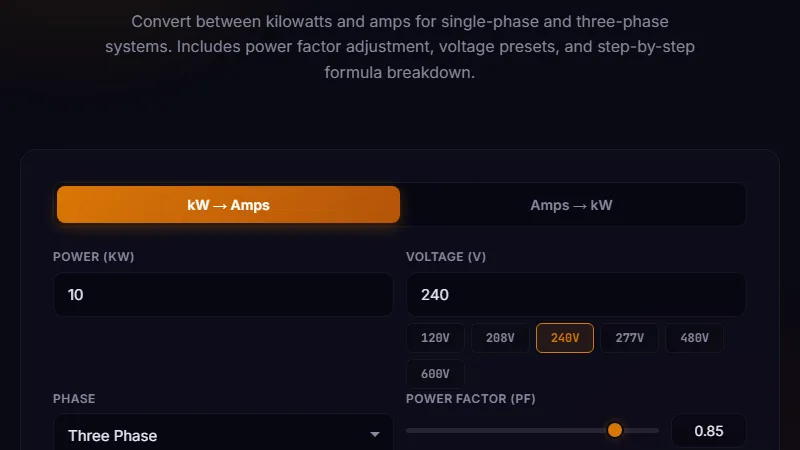
Input: Single-phase, 240V, 7.5 kW, PF=1.0.
Output: Current = 31.25A. Recommended breaker: 40A (125% of continuous load). Wire: 8 AWG.
Same load with PF=0.8: Current = 39.1A. Breaker: 50A. Wire: 6 AWG. Power factor alone changes the wire size by two gauges.
Sizing a Generator for a Mixed Load
Tom is buying a generator for his workshop. He adds up his loads: a 5 kW motor-driven saw, 3 kW of LED lighting, a 2 kW compressor, and 1 kW of miscellaneous outlets. Total: 11 kW. But the saw has a power factor of 0.8 and needs 6250 VA. The compressor has a starting surge of 3x running current. Using the calculator, he converts each load to amps at 240V single-phase with its specific power factor. The saw: 5000 / (240 x 0.8) = 26.0A. Lighting (PF 0.95): 3000 / (240 x 0.95) = 13.2A. Compressor: 2000 / (240 x 0.85) = 9.8A. Total running current: 52.7A. But starting the saw adds 52A momentarily, and the compressor also starts. He needs a generator that can deliver at least 52.7A continuous and handle 78A momentary. That's about 15 kVA, not 11 kVA. The calculator shows the gap between kW and kVA clearly.
Checking an Existing Circuit for a New Machine
Maria has a 480V three-phase 30A circuit running to a CNC machine. The manufacturer says the new machine draws 18 kW. She runs the calculator: three-phase, 480V, 18 kW, PF=0.85. Current = 18000 / (480 x 1.732 x 0.85) = 25.5A. The existing 30A circuit is adequate — barely. But with 125% continuous load requirements, the breaker should handle 31.9A. That's over 30A. She needs to bump the circuit to 40A or verify the machine is non-continuous duty. Without the calculator, she might have assumed 18 kW at 480V is 18000 / 480 = 37.5A (ignoring three-phase and PF) and thought the circuit was undersized, leading to an unnecessary panel upgrade costing thousands.
Limitations
The calculator assumes balanced loads for three-phase systems. If the phases are significantly unbalanced (e.g., a three-phase panel feeding single-phase loads randomly), the per-phase currents vary and the simple formula understates the peak phase current. For unbalanced systems, use the highest per-phase load for wire and breaker sizing. The tool also doesn't account for harmonic currents — VFDs and switching power supplies can have high harmonic content that increases RMS current without contributing to real power. For those loads, use a true RMS meter and size conductors for the measured current, not the calculated value.
Power factor correction equipment changes the power factor dynamically. If your system has PF correction capacitors, the utility-side current will be lower than the load-side current. The calculator gives you the load-side current. For utility sizing, use the corrected power factor.
FAQ
What power factor should I use?
For resistive loads (heaters, incandescent lights), use 1.0. For induction motors, use 0.8-0.85. For LED lighting with quality drivers, 0.9-0.95. For fluorescent lighting with magnetic ballasts, 0.5-0.6. If unsure, 0.85 is a reasonable default for mixed loads.
Why does three-phase use less current than single-phase for the same power?
Three-phase delivers power in three overlapping sine waves. The total instantaneous power is constant rather than pulsing, so less peak current is needed for the same average power. The sqrt(3) factor in the formula is the mathematical expression of this efficiency.
How do I convert horsepower to kW?
1 HP = 0.746 kW. A 10 HP motor has 7.46 kW of mechanical output power. But the electrical input power is higher due to motor efficiency. A 10 HP motor at 90% efficiency draws 7.46 / 0.9 = 8.29 kW from the supply.
Does the calculator work for DC circuits?
Yes. For DC, amps = kW x 1000 / volts. No power factor or efficiency factors needed. This is useful for solar panel arrays, battery banks, and DC motor circuits.
What size breaker do I need for a given kW load?
The NEC requires breakers sized at 125% of the continuous load current. For a 30A continuous load, use a 40A breaker. For non-continuous loads, 100% is acceptable. The calculator shows the recommended breaker size based on this rule.
Conclusion
Use the kW to amps calculator whenever you're sizing breakers, wires, or generators for any electrical load. It prevents the common mistakes — forgetting power factor, ignoring three-phase math, or confusing input and output power for motors. Don't use it for heavily unbalanced three-phase systems without checking each phase individually. And for nonlinear loads with significant harmonics, verify the calculated values against actual measured current. For most industrial and commercial applications, the calculator gives the right starting point for safe electrical design.
For the downstream wiring after the breaker, the voltage drop calculator and ampacity calculator complete the wire-sizing trio.
? Back to Blog