Dog Years to Human Years — Breed Size Changes Everything
What It Solves
The old rule says one dog year equals seven human years. A 5-year-old dog would be 35 in human terms. That math is wrong. The rule came from a simple average — humans live about 80 years, dogs live about 11, so 80 divided by 11 is roughly 7. But dogs age faster in their early years and slower later on. More importantly, breed size changes everything. A 5-year-old Chihuahua is roughly 36 in human years, while a 5-year-old Great Dane is about 49. That 13-year gap matters when you're making health decisions for your dog. The tool applies the current veterinary science formulas instead of the old myth.
The Real Problem
Veterinarians stopped using the 7-year rule years ago. Research published in 2020 mapped DNA methylation patterns in dogs and found that aging follows a logarithmic curve, not a straight line. Dogs reach sexual maturity around 6-12 months (equivalent to a human teenager), then the rate slows. By year two, a dog of any size is roughly 24 in human years. After that, small breeds age about 4 human years per calendar year, medium breeds about 5, large breeds about 6, and giant breeds about 7-8. The problem is that most dog owners still believe the flat 7x multiplier. They underestimate their large breed dog's true age and miss early signs of aging. Or they overestimate their small dog's age and worry unnecessarily.
The gap widens dramatically in senior years. A 12-year-old Yorkshire Terrier is about 64 in human years — still spry for its size. A 12-year-old Great Dane is about 102 — well past its life expectancy of 8-10 years. Treating both dogs the same way based on a 7-year formula leads to poor health decisions.
How to Use It
Select your dog's weight category — small (under 20 lbs), medium (21-50 lbs), large (51-90 lbs), or giant (over 90 lbs). Enter the dog's age in years. The tool applies the correct formula per size category. For the first two years, all dogs use the same curve: 15 human years for year one, plus 9 for year two. After that, the annual multiplier varies by size. The tool shows the human-equivalent age and the life stage — puppy, adolescent, adult, mature, senior, or geriatric.
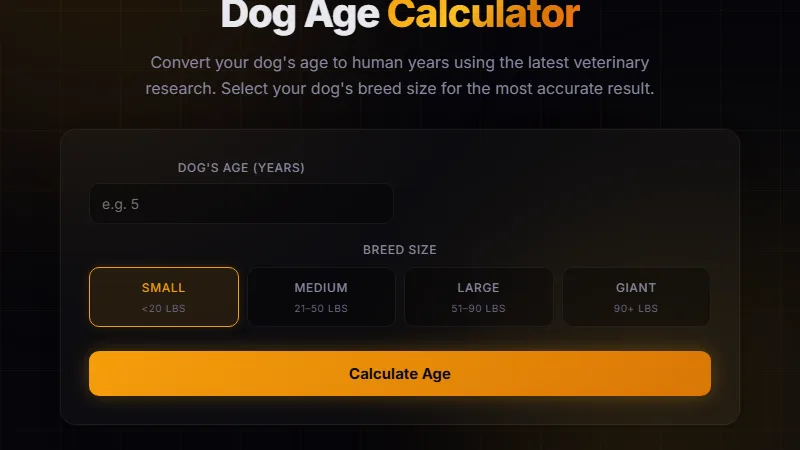
Standard 7-year rule: 42 human years.
Actual formula: 15 (first year) + 9 (second year) + 4 x 4 (years 3-6) = 40 human years.
Life stage: Adult, approaching mature (which starts around 7-8 years for medium breeds).
The Beagle still has several good years before entering senior territory around age 10-11.
Veterinary Visits and Life Stage Awareness
Knowing the correct human-equivalent age helps schedule appropriate veterinary care. Small breeds should start senior bloodwork around age 10-11 (about 56-60 human equivalent). Large breeds need senior screening by age 6-7 (about 49-55 human equivalent). A veterinarian using the 7-year rule would recommend senior screening for a small breed at age 10 anyway (70 in the old math), which is coincidentally close. But for large breeds, the old rule says 7 x 6 = 42, suggesting the dog is middle-aged when it's actually nearing senior status. The tool helps owners budget for the right care at the right time.
Choosing the Right Food and Exercise Plan
Nutritional needs change as dogs age. A small breed labeled "adult" at 12 months is correct because small breeds reach physical maturity around 10-12 months. But a large breed switched to adult food at 12 months is being fed wrong — large breeds need puppy food until 18-24 months to support proper bone and joint development. The tool's life stage output tells you whether your dog is still in the adolescent phase or has reached adulthood, which directly affects feeding schedules. Similarly, exercise expectations should shift. A 7-year-old Labrador (medium-large, about 50 human equivalent) still needs daily exercise but shouldn't be pushed for long runs on concrete the way a 3-year-old (about 28 human equivalent) can handle.
Limitations
The tool uses size-based formulas that are averages across breeds. Individual dogs within a size category can age differently based on genetics, diet, exercise, and healthcare. Mixed-breed dogs may have aging rates that fall between size categories. The tool doesn't account for breed-specific longevity — for example, a Chihuahua (small) typically lives 14-16 years, while a French Bulldog (also small) averages 10-12 years. The life stage labels are general guidelines. Consult your veterinarian for breed-specific health planning. The logarithmic formula loses precision for very old dogs (past 15 years) where data becomes sparse.
FAQ
Why do small dogs live longer than large dogs?
The exact mechanism isn't fully understood, but research points to growth rate. Large breeds grow rapidly, which increases cellular turnover and oxidative stress. The faster a dog grows, the faster it ages at the cellular level. Small breeds have slower growth rates and lower metabolic demands, which correlates with longer lifespans.
Does neutering or spaying affect dog aging?
Studies show neutered dogs live slightly longer on average, but the effect is small (6-18 months) and primarily due to reduced cancer risks in reproductive organs. The aging formulas assume a neutered or intact status doesn't change the human-equivalent age calculation.
Is the first year really equal to 15 human years?
Yes — that's based on observed developmental milestones. A 6-month-old puppy reaches sexual maturity (comparable to a human preteen). By 12 months, most dogs have adult teeth, full height, and behavioral maturity comparable to a 15-year-old human. The 15-year figure comes from veterinary behavior and development studies.
What if my dog is a giant breed like a Great Dane?
Giant breeds (over 90 lbs) age fastest after year two. Their annual multiplier is approximately 7-8 human years per calendar year. A 6-year-old Great Dane is roughly 63-65 in human years, and most Great Danes reach geriatric status by age 7-8. The tool applies the highest post-year-two multiplier for giant breeds.
Should I use this for cats too?
No — cats have a different aging curve. A cat's first year equals about 15 human years, year two adds 9 (same as dogs), but after that cats age about 4 human years per calendar year regardless of breed size. Most cats reach senior status around age 11 (about 60 human equivalent).
Conclusion
Use this tool when you want an accurate human-equivalent age for your dog based on current veterinary research instead of the outdated 7-year myth. It's most valuable when making health decisions — timing senior screenings, switching foods, adjusting exercise intensity. Don't use it as a substitute for breed-specific veterinary advice. The formulas are averages, and your individual dog's health, genetics, and lifestyle matter. If your dog is a mixed breed whose weight puts it between two size categories, try both and discuss the range with your vet. For cat owners, check the feline-specific resources instead.
If you're tracking life milestones for yourself or family members, the exact age calculator covers human ages down to seconds, and the date difference calculator helps count days between important dates like adoption day or a dog's birthday.
← Back to Blog