Voltage Drop — How to Size Electrical Cables the Right Way
What It Solves
Every wire has resistance. When current flows through that resistance, voltage drops. The farther the wire runs and the more current it carries, the more voltage you lose. If the drop is too high, equipment malfunctions — motors run hot, lights dim, chargers take forever. Voltage drop calculations tell you the minimum wire size needed for a given distance, current, and acceptable loss.
The Real Problem
Most electricians and engineers know the principle but get tripped up by the variables. Distance isn't just the straight-line path — it's the round trip for DC circuits or the one-way length times two for single-phase AC. Wire material matters too: copper has about 60% of the resistance of aluminum for the same size. And phase changes everything: three-phase systems drop less voltage than single-phase because the current splits across three conductors.
Here's a typical scenario. You're running a 120V circuit 150 feet to power a 15-amp lighting load. Using 14 AWG copper, the voltage drop is about 7.2 volts — that's a 6% drop. The NEC recommends staying under 3% for branch circuits and 5% total. Your 14 AWG wire fails. Stepping up to 12 AWG drops it to 4.5 volts (3.75%), which passes. The difference between guessing and calculating is a tripped breaker or a failed inspection.
The same problem scales. A 480V three-phase motor feeder running 500 feet on 250 kcmil aluminum drops only 2.1% — acceptable. But if someone subs 4/0 aluminum thinking it's close enough, the drop jumps to 3.4%, the motor sees undervoltage, and the contractor eats a re-pull cost.
How to Use It
Open the voltage drop calculator. Select your phase — DC, single-phase AC, or three-phase AC. Enter the source voltage (120V, 240V, 277V, 480V are common). Enter the current in amps, or enter power in watts if you know the load that way. Set the wire material (copper or aluminum). Choose the wire size from the dropdown — the calculator knows the resistance per 1000 feet for each size. Enter the one-way distance from source to load. Set your target maximum drop (3% is standard, 5% is the NEC cap). The tool tells you the actual voltage drop percentage, the voltage at the load, and whether your wire size passes or fails. If it fails, bump up the wire size and recalculate.
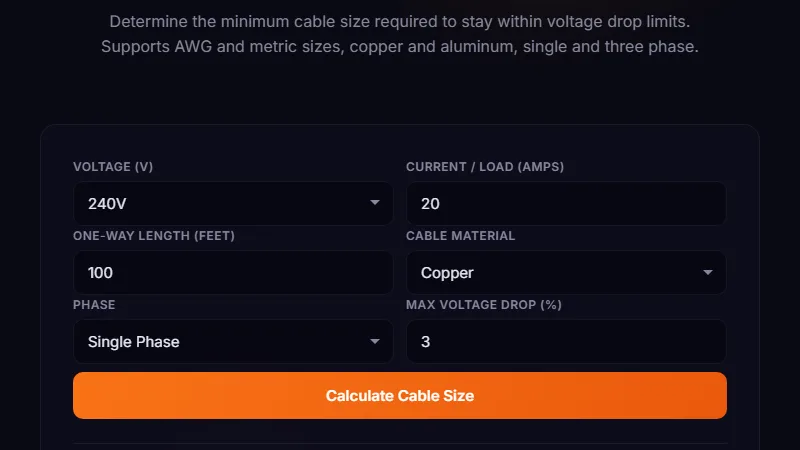
Input: 240V, single-phase, 40A, copper, 200 ft, 3%.
Output: 8 AWG recommended. Voltage drop: 5.9V (2.46%). Voltage at load: 234.1V. Status: PASS.
Trying 10 AWG gives 9.5V (3.95%) — FAIL. Without the calculator, someone might grab 10 AWG because it's rated for 40A in most conditions.
Sizing a Long-Distance Subpanel Feed
Elena is running a 100A subpanel to a detached garage 300 feet from the main panel. The main is 240V split phase. She starts with 2 AWG aluminum (common for 100A feeder). The calculator shows a 5.8% drop — over the 5% limit. She bumps to 1/0 aluminum: 4.1%, passes. The cost difference between 2 AWG and 1/0 aluminum is about $0.30 per foot — $90 extra for 300 feet, but it avoids voltage issues at the garage. The calculator turned a guess into a decision.
Matching Wire to Motor Starting Current
A 15 HP motor draws about 42A at full load, but starting current can hit 250A for a few seconds. Carlos runs a three-phase 480V motor 400 feet from the panel using 6 AWG copper. At full load, the drop is 2.1%. But at startup, the momentary drop hits 12.5%. The motor contactor could drop out. Bumping to 4 AWG copper cuts startup drop to 7.9%. The calculator lets him check both steady-state and startup scenarios by changing the current value.
Limitations
The calculator uses standard NEC resistance values for copper and aluminum at 75°C. Actual resistance varies with temperature — hot wires have higher resistance. For highly loaded circuits in hot environments, real voltage drop may be 5-10% higher than calculated. The tool also assumes continuous current. For intermittent loads, the voltage drop at peak current is what matters, but the average drop is lower. Harmonic currents from VFD drives and nonlinear loads can increase effective resistance due to skin effect, which the calculator doesn't model.
Voltage drop calculations don't replace ampacity checks. A wire might pass voltage drop at 3% but exceed its ampacity rating for the installation conditions. Always check both. And for circuits longer than 500 feet, consider voltage drop mitigation strategies like higher voltage distribution or transformers — the calculator will tell you the drop, but it won't suggest the system redesign.
FAQ
What is the maximum allowable voltage drop?
The NEC recommends 3% for branch circuits and 5% total from the service point to the farthest load. Some equipment has stricter requirements — motors may need under 2% at startup, and some electronics are sensitive to drops below 105V on a 120V line.
Does wire temperature affect voltage drop?
Yes. Resistance increases with temperature. NEC values are typically given at 75°C. At 90°C, resistance is about 5% higher. At 20°C (room temp), it's about 10% lower. For critical circuits, use the higher temperature values to be conservative.
Why does three-phase have less voltage drop than single-phase?
In three-phase systems, the current divides across three conductors, and the return path uses the other phases instead of a separate neutral. The effective circuit length is shorter. For the same current and distance, three-phase drop is about 87% of single-phase drop.
Can I use aluminum wire for long runs?
Yes, but it needs to be upsized. Aluminum has about 60% more resistance than copper for the same size. For a given voltage drop target, aluminum needs to be roughly two AWG sizes larger than copper. The calculator handles this automatically when you switch material.
What happens if voltage drop exceeds the limit?
Equipment sees undervoltage. Motors draw more current and can overheat. Lights dim noticeably. Power supplies may drop out or operate inefficiently. Voltage drop that's too high is both a performance issue and a safety concern over time.
Conclusion
Use this calculator any time you're running wire more than 100 feet, feeding a subpanel, or wiring equipment with sensitive voltage requirements. It ensures you pick the right size the first time. Don't use it as a substitute for the ampacity check required by code — voltage drop and ampacity are separate constraints, and both must be satisfied. For short circuits under 50 feet, voltage drop is usually negligible for properly sized wire. For anything longer, run the numbers.
If you're also calculating conduit fill or wire ampacity for the same job, check the conduit fill guide and ampacity guide — all three factors (drop, fill, ampacity) interact in real installations.
← Back to Blog