VA Loans — How the Funding Fee Works and What Your Monthly Payment Looks Like
The VA loan program is one of the most powerful benefits available to veterans and active-duty service members. It offers no down payment, competitive interest rates, and no private mortgage insurance. But the funding fee and monthly payment calculations can be confusing. This post breaks down how the funding fee tiers work, what your monthly payment actually includes, and how purchase loans differ from refinances.
What the VA Funding Fee Is and Why It Exists
The VA funding fee is a one-time charge that helps offset the cost of the loan program to taxpayers. It applies to most VA-backed purchase loans and refinances, though some veterans are exempt. The fee is calculated as a percentage of the loan amount and varies based on your service category, down payment amount, and whether you are buying or refinancing. The fee can be paid at closing or rolled into the loan amount.
Funding Fee Tiers by Service Category
For regular military veterans, the first-time use funding fee with zero down payment is 2.15% of the loan amount. With a 5% down payment it drops to 1.50%, and with 10% or more down it falls to 1.25%. For subsequent uses, the fee is higher: 3.30% with zero down, 1.50% with 5% down, and 1.25% with 10% down. National Guard and Reserve members pay slightly higher rates: 2.40% for first use with zero down.
Example
A first-time buyer using a $400,000 VA loan with zero down payment pays a 2.15% funding fee of $8,600. If they roll this into the loan, the total loan becomes $408,600. The monthly payment on a 30-year fixed rate at 6.5% would be approximately $2,583 for principal and interest, plus taxes, insurance, and any homeowners association fees.
Monthly Payment Breakdown
Your monthly VA loan payment consists of principal and interest, property taxes, homeowners insurance, and potentially a homeowners association fee. There is no private mortgage insurance, which is a significant savings compared to conventional loans. The principal and interest portion is determined by the loan amount, interest rate, and term. Taxes and insurance are typically held in an escrow account and paid by the lender on your behalf.
Purchase Loans vs IRRL Refinances
VA purchase loans are for buying a home. The funding fee ranges from 1.25% to 3.30% depending on down payment and prior use. VA Interest Rate Reduction Refinance Loans have a fixed funding fee of 0.50% regardless of service category or prior use. Cash-out refinances have a funding fee of 2.15% for first use and 3.30% for subsequent use. Native American Direct Loans have a 1.25% fee.
Funding Fee Exemptions
Some veterans are exempt from the funding fee entirely. This includes veterans receiving VA disability compensation, veterans who would be entitled to compensation if not for receipt of military retirement or active-duty pay, surviving spouses of veterans who died in service or from service-connected disabilities, and service members with a rating for a pre-discharge claim. If you qualify for an exemption, you must provide the appropriate documentation.
Limitations to Consider
The calculator provides accurate funding fee and monthly payment estimates, but actual rates depend on your lender, credit score, and current market conditions. The funding fee is based on the loan amount, not the purchase price, and rolling the fee into the loan means you pay interest on it for the entire term. VA loans require a valid Certificate of Eligibility, and the property must meet minimum VA appraisal standards.
Frequently Asked Questions
Can I roll the VA funding fee into my loan?
Yes, the funding fee can be financed as part of the loan. However, this increases your total loan amount and the interest you pay over the life of the loan. Many borrowers choose to pay it at closing to keep the loan amount lower.
Is the VA funding fee tax deductible?
The funding fee is not deductible as a mortgage interest deduction in the year you pay it. However, it may be deducted as a mortgage insurance premium in some cases. Consult a tax professional for your specific situation.
How does the funding fee differ for a second use?
For a second use with zero down, the funding fee increases to 3.30% compared to 2.15% for first use. This is because the guaranty entitlement is partially restored after the first loan is paid off.
What happens to the funding fee if I refinance?
If you refinance an existing VA loan with an IRRL, the funding fee is only 0.50% of the loan amount. For cash-out refinances, the fee follows the standard purchase loan rates based on usage.
Do surviving spouses pay the funding fee?
Surviving spouses of veterans who died in service or from service-connected disabilities are exempt from the funding fee. Other surviving spouse scenarios may require the fee.
When to Use a VA Loan vs Other Options
A VA loan is the best choice when you have no down payment, want to avoid private mortgage insurance, or have less-than-perfect credit. Conventional loans may be better if you have a large down payment and excellent credit, or if you are buying a property that may not meet VA appraisal standards. The calculator helps you understand the full cost structure so you can compare total monthly payments across loan types.
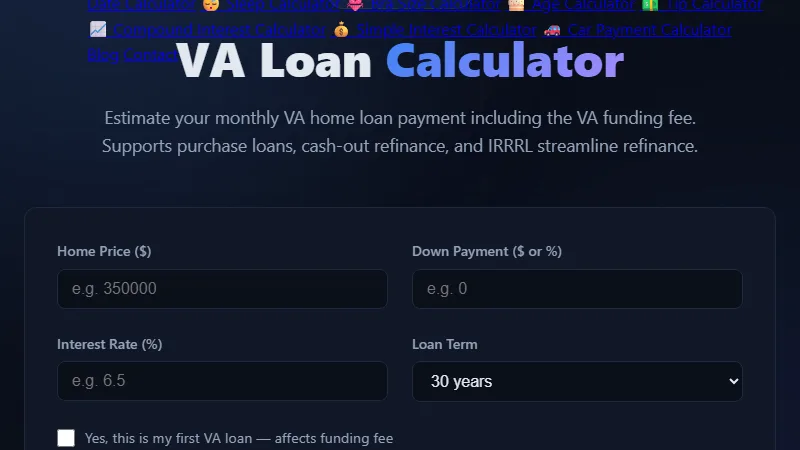
Try the VA Loan Calculator
Estimate your VA funding fee and monthly payment instantly with accurate tier-based calculations.
🏠 Use the Calculator →