Compound Interest — How to Calculate Investment Growth with Real Numbers
What It Solves
Compound interest is the single most powerful force in personal finance, yet most explanations of it are useless. They toss around phrases like "exponential growth" and "the eighth wonder of the world" without showing you what it actually looks like with your numbers. The calculator solves this. You enter your starting balance, monthly contribution, interest rate, compounding frequency, and time horizon. It shows the total growth year by year, the final balance, how much of that is your own money versus earnings, and — critically — what inflation does to the real purchasing power of your returns.
The Real Problem
The real problem is that the numbers are so small in the early years that it is hard to believe the process works. If you invest $200 a month at 7 percent annual return, after one year you have about $2,484 of which $84 is interest. That does not feel transformative. After ten years the total is about $34,600 with $10,600 in earnings. Still modest. After thirty years — assuming the same $200 a month — the total passes $244,000 with more than $172,000 in earnings. The last decade alone adds over $140,000. That is the curve. People quit in year three because the numbers are boring, but the entire payoff is concentrated in the final third of the time horizon. The calculator makes that visible by showing the year-by-year breakdown.
How to Use It
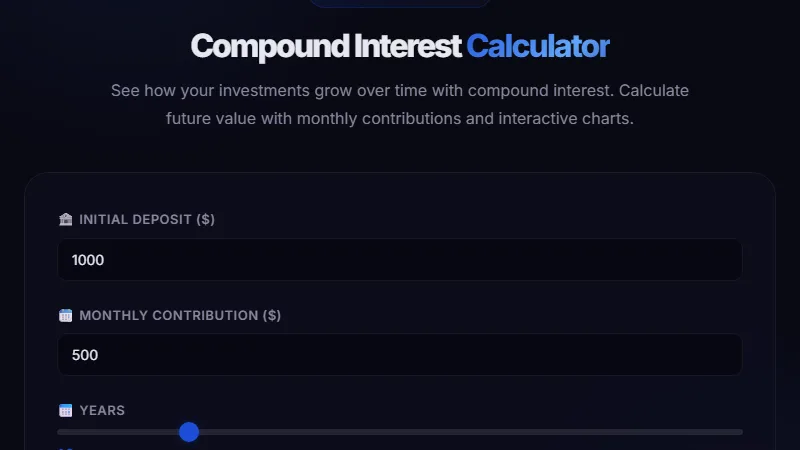
Open the calculator and enter five numbers: your initial balance (could be zero), your monthly contribution, the expected annual interest rate, how many times per year it compounds, and how many years you plan to invest. The result page shows the final balance, total contributions, total interest earned, and an inflation-adjusted figure that shows what the final balance would be worth in today's dollars. Below that is a growth chart and a full year-by-year table.
Walkthrough
Set initial balance to $1,000. Monthly contribution to $500. Rate to 8 percent. Compounding to monthly. Time to 25 years. The calculator returns a final balance of $497,000 approximately. Your total contributions are $151,000. The interest earned is $346,000. After adjusting for 3 percent inflation, the real purchasing power of that half-million is about $237,000 in today's dollars. That is the number that matters for retirement planning, not the nominal figure.
Comparing Compounding Frequencies
One practical use of the calculator is comparing how often interest compounds. A $10,000 investment at 6 percent annual interest compounded annually yields $57,435 after 30 years. The same investment compounded monthly yields $58,428. Compounded daily yields $58,476. The difference between annual and daily compounding is about $1,000 on $10,000 over 30 years — meaningful but not life-changing. Where compounding frequency matters more is with loans and credit cards, where daily compounding on a high balance can add significantly to what you owe. Use the calculator to test both scenarios with your actual numbers before making decisions.
Adjusting for Inflation
The inflation-adjusted figure is the most underused feature in any investment calculator. A 7 percent nominal return with 3 percent inflation yields only a 3.88 percent real return after the inflation adjustment. Over 30 years, that difference cuts the purchasing power of your portfolio roughly in half. The calculator applies the inflation adjustment to the final balance so you can see what you will actually be able to buy with the money, not just the nominal number. When planning for retirement, always use the inflation-adjusted figure as your target. If the calculator says you need $1.5 million nominal, the real target is around $750,000 in today's spending power, assuming 3 percent inflation over 30 years. This prevents the common mistake of aiming for a nominal number that turns out to be insufficient.
Limitations
The calculator assumes a fixed rate of return every year. Real markets do not work that way. A sequence of returns risk — where poor returns early in retirement deplete the portfolio faster than expected — is not captured. The inflation adjustment uses a constant rate, but real inflation varies year to year. The calculator does not model taxes on investment gains, which can reduce returns significantly depending on the account type (taxable brokerage versus IRA versus 401k). It also does not account for fees, expense ratios, or management costs, which can eat 0.5 to 2 percent of returns annually. Treat the results as a rough projection, not a guarantee.
FAQ
What rate should I use for stock market returns?
A reasonable long-term estimate for a diversified stock portfolio is 7 to 10 percent nominal before inflation. After inflation, 4 to 7 percent real. Use the lower end for conservative planning and the higher end for optimistic scenarios.
Does compounding frequency matter that much?
For long-term investing, not as much as you might think. Monthly vs annual compounding adds roughly 0.3 percent to the effective annual rate. Daily compounding adds a tiny fraction more. The contribution amount and time horizon matter far more.
How does starting early affect the outcome?
Starting at 25 vs 35 with the same monthly contribution and rate roughly doubles the final balance. The first ten years of compounding set the trajectory for everything that follows. Delay is the most expensive mistake.
Should I use nominal or real return for planning?
Use real return (after inflation) for retirement planning. The nominal number is misleading because prices rise over time. The calculator shows both, but the inflation-adjusted figure is the one that tells you what you can actually spend.
What if I stop contributing after some years?
The calculator does not model variable contributions. For that, build a spreadsheet. As a rule of thumb, the compounding on existing assets eventually outstrips new contributions. After 15 to 20 years, most of your growth comes from the compounding of what you already have, not from new money.
Conclusion
Use the calculator when you need to set a savings target, compare investment scenarios, or decide whether to increase your monthly contribution. Do not rely on it for precise retirement planning — it is a projection tool, not a financial plan. Combine it with a more detailed retirement model that accounts for taxes, sequence of returns, variable contributions, and changing spending needs. The single best use of the calculator is answering the question "what happens if I start now versus later?" and letting the year-by-year numbers convince you to start today.
For loans and debt calculations, the amortization calculator and simple interest calculator are useful companions for understanding the other side of the interest equation.
← Back to Blog