Tipping Calculator — How to Split the Bill and Calculate Gratuity Fairly
What It Solves
Tipping involves two separate calculations that most people combine into one fuzzy guess: how much to tip based on service quality, and how to split the total fairly among a group. The fuzzy guess leads to generous tippers overpaying and frugal ones under-tipping, while the person stuck doing the math at the table usually ends up covering the difference out of awkwardness.
The Real-World Problem
The classic dinner-out scenario: six friends, one bill for $287. The service was good but not amazing. Everyone agrees on 18 percent. Someone calculates 18 percent of $287, gets $51.66, adds it to the total for $338.66. Then they try to divide by six. That is $56.44 per person. But three people had cocktails and two had wine by the glass while one person drank water. The split is not equal because the beverages were different. The person with water ends up subsidizing the wine drinkers. Resentment builds. The next dinner out, someone suggests "separate checks please" and the waiter sighs.
This is the fundamental tension of group dining. Equal splitting is simple but unfair when consumption varies. Itemized splitting is fair but requires a spreadsheet at the table. The tip calculation becomes even more complicated when you consider that in some cultures the tip is included in the service charge, in others it is calculated on the pre-tax amount, and in a few it is considered offensive to tip at all.
How to Use It
Start with the total bill amount. Choose the tip percentage or enter a custom amount. Select whether the tip is calculated on the pre-tax or post-tax amount — this matters when the tax rate is high. Add the number of people splitting. The tool shows the total with tip, the amount per person for an equal split, and the breakdown if you need to split unevenly. For itemized splitting, enter each person's individual charges and the tool handles the proportion.
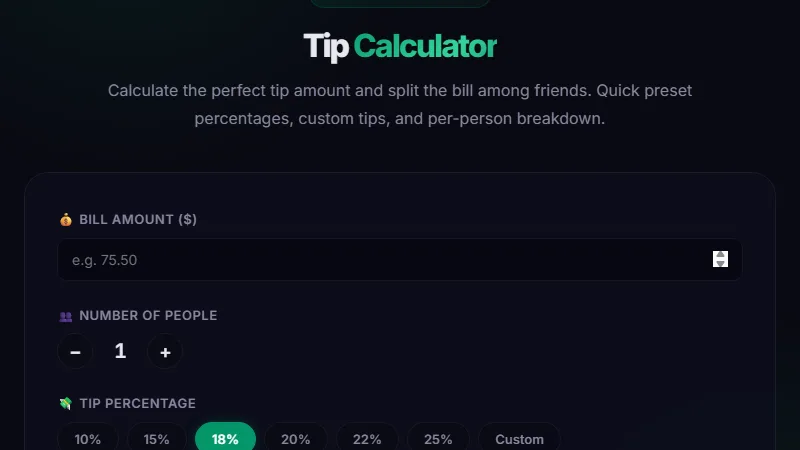
Tip: $31.36. Total with tip: $188.16. Tax: $12.54.
Split 4 ways: $47.04 each.
Uneven split: Person A had $52, Person B $41, Person C $35, Person D $28.80.
Each pays their share plus proportional tip: 20% of their individual amount.
Splitting the Bill on a Business Dinner
Raj is hosting a business dinner with three clients. The bill is $420. He needs to pay for his clients but wants to separate his own drink. His dinner costs $85, client A is $110, client B is $95, and client C is $130. He enters each person's amount, sets the tip to 20 percent on the pre-tax subtotal. The tool calculates each person's proportional tip. Raj pays his share plus the full tip on all client meals as a business expense. He now has an itemized receipt for reimbursement and the tip percentage is clearly documented.
Adjusting for Service Quality
Sarah received excellent service at a fine dining restaurant. The bill is $230. She wants to tip 25 percent. But she also had a brief exchange with the sommelier who recommended a bottle that was $15 over her budget. She adds a separate $5 for the sommelier as a direct tip. The tool lets her enter the base tip percentage and then add an additional amount. The total tip becomes $57.50 plus $5 equals $62.50, or 27 percent. She leaves feeling good about recognizing the sommelier without inflating the standard tip percentage for the server who was already getting a generous rate.
Limitations
The tool cannot read the room. It calculates numbers, not social dynamics. If you are at a table where one person insists on paying the whole bill and having everyone Venmo them, the tool handles the math but not the awkwardness. It also does not know local tipping customs — in Japan, tipping is not practiced and can be seen as rude. In the United States, 15 to 20 percent is standard for full service. In many European countries, service is included but a small additional tip is appreciated. The percentages in the tool are defaults — adjust them based on where you are dining.
The itemized split assumes you know each person's individual charges. If the table shared appetizers and a bottle of wine, you need to decide how to allocate those shared costs before entering the numbers.
FAQ
Should I tip on the pre-tax or post-tax amount?
Convention in the United States is to tip on the pre-tax amount. But many people tip on the total out of habit. Tipping on pre-tax is slightly more accurate since tax is not a service provided by the staff. The difference on a $100 bill with 8 percent tax and 20 percent tip is $1.60 — not huge, but it adds up.
How do I handle a mandatory service charge?
Many restaurants add an automatic gratuity for parties of 6 or more, typically 18 percent. This goes to the restaurant, not necessarily the server. You can add an additional tip on top if the service was exceptional. The tool lets you enter the service charge as a fixed amount and add extra tip separately.
What is the right tip for takeout?
Takeout tips are typically lower than dine-in tips. Five to 10 percent is common, or a flat $2 to $5 for smaller orders. The reasoning is that the server is not providing table service, but the kitchen staff and packaging effort still deserve recognition.
How do I tip on a comped item?
Tip on the value of the comped item, not the zero price. If the restaurant comps your dessert worth $12, include $12 in the bill amount for tip calculation purposes. The server still worked for that comped item.
Should I tip on gift certificates?
Yes. Tip on the full value of the meal before the gift certificate is applied. If your meal is $80 and you pay with a $50 gift certificate, tip on $80, not $30. The server's work is the same regardless of how you pay.
Conclusion
Use this method whenever you are dining out in a group or calculating an appropriate tip for any service. It removes the guesswork and the social friction of dividing the bill. Do not rely on it for cultures or countries where tipping is not customary — in those settings, follow local norms. For everyday dining, it ensures everyone pays their fair share and the service staff receives appropriate recognition.
If you are also calculating how to split ongoing household expenses or travel costs among roommates, the split bill calculator handles recurring shared expenses. The salary to hourly converter is also useful for comparing hourly wages when deciding whether eating out fits your budget.
← Back to Blog