Measuring Square Footage — For Any Room Shape and Layout
What It Solves
Square footage is the foundation of almost every home improvement project. Flooring, paint, tile, concrete, sod, heating and cooling loads, property listings, and material orders all start with the floor area. But most homes are not perfect rectangles. They have closets, alcoves, angled walls, curved bays, and open-plan layouts that merge multiple rooms. Measuring these spaces correctly requires breaking them into their geometric parts and applying the right formula for each one.
The Real-World Problem
A homeowner lists their house for sale. The tax records say 2,100 square feet. The appraiser measures it and gets 1,980. The discrepancy costs the seller $15,000 in perceived value. What happened? The tax assessor measured the exterior dimensions including wall thickness, while real estate square footage is measured from the interior wall surfaces. Finished basements, garages, and covered porches count differently depending on local rules. And rooms with sloped ceilings have height requirements — areas under 5 feet of headroom do not count as living space in most jurisdictions.
In renovation projects, the problem is more immediate. A contractor quotes $8 per square foot for tile installation based on the homeowner's measurement of 200 square feet. The actual floor area after measuring correctly is 230. The homeowner is either paying $240 more than expected or the contractor walks off the job.
How to Use It
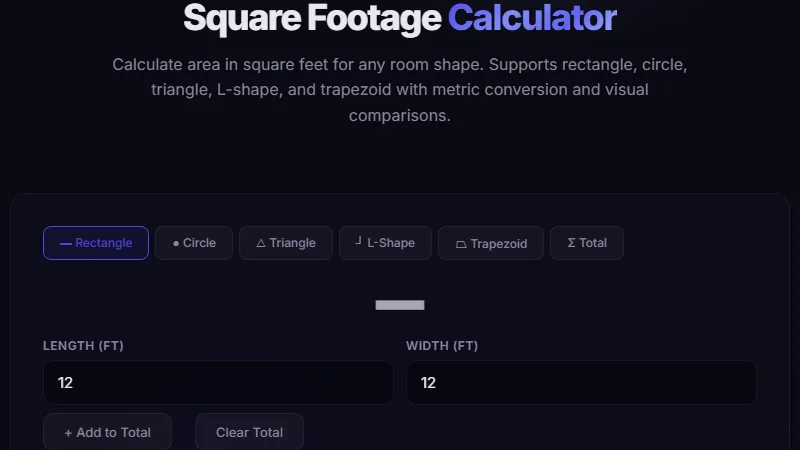
Start by sketching the room and dividing it into simple shapes. Measure each section in feet and inches. For a rectangle, enter length and width. For a triangle (common in attic rooms with sloped ceilings), enter base and height. For a circle or half-circle (bay windows, round towers), enter the diameter. The tool automatically computes the area for each shape. Add as many sections as needed and review the running total.
Rectangle 1: 20 x 15 = 300 sq ft.
Rectangle 2: 12 x 8 = 96 sq ft.
Total: 396 sq ft. No need to guess the L-shape formula — just split it into two rectangles.
Measuring an Attic Bedroom with Sloped Ceilings
An attic conversion has a 20x15-foot floor plan, but the sloped ceiling cuts into the usable area. The center section with full headroom (over 7 feet) is 12x15 feet. The two side sections under the slope each measure 4 feet wide at the base of the triangle and 6 feet tall at the peak. She uses the rectangle for the center and two triangles for the sloped sides. The total usable square footage is 180 plus 24 plus 24 equals 228 square feet — significantly less than the 300-square-foot floor footprint. This matters for both the building permit and the flooring order.
Calculating Total Home Square Footage for Listing Purposes
Tom is preparing to sell his split-level home. He needs the total square footage for the real estate listing. He measures each room individually, including closets as separate rectangles. The main floor has a living room, kitchen, and half bath. The upper level has three bedrooms and a full bath. The lower level has a family room and a utility room. He enters each area as a separate section. The tool sums everything. He discovers the finished lower level family room adds 420 square feet of below-grade space — which counts as finished square footage but is often listed separately from above-grade living area. He now has the numbers ready for both the appraisal and the listing description.
Limitations
The tool calculates geometric area based on your measurements. It does not apply local real estate rules about what counts as livable square footage. For listing purposes, consult the local MLS guidelines. For irregular free-form shapes, you need to approximate using simpler geometry or use a digital measuring tool. The accuracy of the result depends entirely on the accuracy of your measurements — measure twice, enter once.
Wall thickness is not factored in. Exterior measurements (for siding or roofing) will differ from interior measurements (for flooring or paint). The tool assumes you are measuring interior wall-to-wall for floor area. For exterior square footage, measure from the outside of the walls.
FAQ
Should I include closets in square footage?
Yes, interior closets are included in the room's square footage for most purposes. For flooring or paint, include them. For real estate listings, include closets as part of the room.
How do I measure a room with a bay window?
Measure the main room as a rectangle. Measure the bay window area separately — typically a half-circle or a small rectangle. Add the two together. If the bay has angled sides, measure it as a trapezoid and enter the average width.
What about staircases?
Stairs are measured by their footprint on each floor. Measure the length and width of the stairwell opening at the top and count that area on the upper floor. The area under the stairs on the lower floor is typically not counted unless finished.
Does the tool handle metric measurements?
Use feet and inches for all measurements. Convert meters to feet by multiplying by 3.281. The result will be in square feet. For square meters, divide the square footage result by 10.764.
What is the difference between gross and net square footage?
Gross includes the full footprint including wall thicknesses. Net measures interior living space wall-to-wall. Real estate listings use net square footage. Construction material estimates use whichever is appropriate for the material type.
Conclusion
Use this method whenever you need accurate floor area for any project, from ordering materials to listing a property. It eliminates the rounding errors and shape assumptions that lead to incorrect estimates. Do not rely on it for structural load calculations or HVAC sizing — those require additional factors like ceiling height, insulation values, and window area. For quick material estimates like paint or flooring, it is the most reliable starting point.
If you are estimating paint after measuring the floorplan, the paint calculator converts wall dimensions to gallons. For flooring material, the flooring calculator builds on the square footage with waste factors and box coverage.
← Back to Blog