Splitting Bills Fairly — Equal Split vs Itemized, Tax, and Tip
Settling a group bill can create tension even among close friends. When one person ordered a starter and soda while another had steak and wine, splitting the total equally feels unfair. This post breaks down the two main approaches, explains proportional tax and tip allocation, and shows you how to use the right method for any situation.
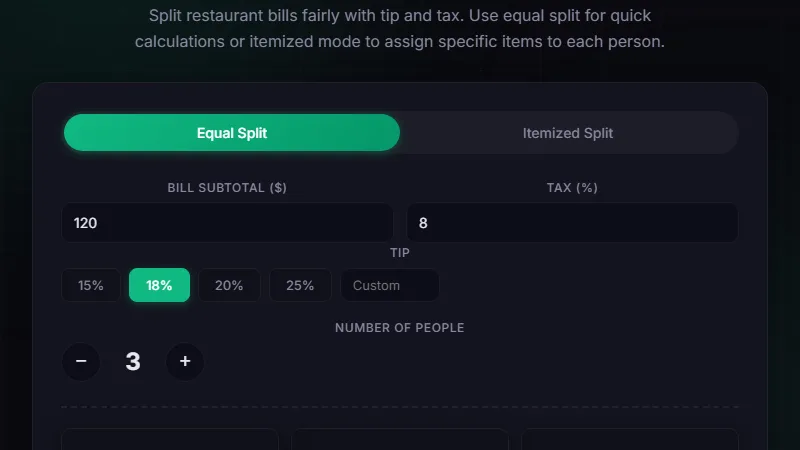
Why Most Group Bill Splits Go Wrong
The core problem is that people consume different amounts but often split costs equally for convenience. A person who ordered a salad ends up subsidizing someone who ordered surf and turf. Over time, this breeds resentment. The real-world scenario is familiar: a dinner with eight colleagues, a shared round of appetizers, three bottles of wine split unevenly, and someone skipping dessert. An equal split would shortchange the light eaters and overcharge everyone who drank less.
The solution lies in choosing the right split method. There are two primary approaches: equal split by headcount and itemized split where each person pays for what they ordered plus a fair share of tax and tip.
Equal Split — Simple but Often Unfair
An equal split divides the total bill including tax and tip evenly among all people. It is fast, requires no itemization, and works well when everyone ordered similarly priced items or agreed beforehand to split evenly. For a group of four ordering similar entrees and sharing a couple of appetizers, equal splitting saves time and mental energy.
Example
Total bill: $240.00. Tax (8%): $19.20. Tip (20% on subtotal): $48.00. Grand total: $307.20. Split four ways: $76.80 per person. This works fine if all four meals were within a few dollars of each other. But if one person ordered a $22 pasta while others ordered $55 steaks and wine, the pasta eater pays $54.80 more than their fair share.
Itemized Split — Fair When Orders Differ
Under an itemized split, each person pays only for the items they ordered. Shared items such as appetizers or bottles of wine are divided equally among the participants. Tax and tip are then applied proportionally based on each person's subtotal rather than split equally. This is the fairest method when individual orders vary significantly in price.
Example
Person A orders $22, Person B orders $55, Person C orders $55, Person D orders $55. A shared appetizer of $15 is split equally ($3.75 each). Tax at 8% and tip at 20% are proportional:
- Person A: $25.75 subtotal + $2.06 tax + $5.15 tip = $32.96
- Person B: $58.75 subtotal + $4.70 tax + $11.75 tip = $75.20
- Person C: $58.75 subtotal + $4.70 tax + $11.75 tip = $75.20
- Person D: $58.75 subtotal + $4.70 tax + $11.75 tip = $75.20
Person A saves $43.84 compared to an equal split. That is the difference between fair and frustrating.
Handling Shared Items Gracefully
Shared appetizers, platters, and bottles should be flagged as shared items in the calculation. The total cost of a shared item is divided equally among all participants before adding individual items. Some groups also apply shared items only to the people who actually consumed them. The key is agreeing on the rule upfront.
Proportional Tax and Tip Allocation
Tax and tip should always be proportional to each person's subtotal rather than split equally. If you split tax equally, someone who ordered $20 pays the same sales tax as someone who ordered $80. The same logic applies to tips. Proportional allocation is the only fair method when using itemized splitting. Our calculator handles this automatically so you do not have to do the math yourself.
Limitations to Keep in Mind
Itemized splitting requires accurate tracking of who ordered what. For large groups with many shared items, this can become tedious. Some restaurants do not provide itemized receipts by default, and drink orders can be hard to attribute after the fact. Equal splitting, while less fair, is often the practical choice for very large groups or informal settings. Neither method handles uneven discount applications such as coupons applied to specific items.
Frequently Asked Questions
Should tax be split equally or proportionally?
Tax should be split proportionally based on each person's food subtotal. Equal tax splitting forces light spenders to pay more tax than their share of the bill warrants.
How do you handle a shared appetizer when some people did not eat it?
The fairest approach is to divide the appetizer only among those who ate it. If that is unclear, splitting equally among everyone is simpler and usually accepted.
What tip percentage is standard for groups?
In the US, 18% to 20% on the pre-tax subtotal is standard for groups of six or more, as many restaurants automatically include gratuity at that rate.
Can you split a bill unevenly without itemizing?
Yes, some calculators support custom split percentages. This works when people agree on specific shares without tracking individual items.
Does proportional tip allocation change the total tip amount?
No. The total tip is the same regardless of how it is allocated. Proportional allocation only changes who pays what share of that fixed amount.
When to Use Each Method
Equal split works best for small groups ordering similarly priced items, casual outings where everyone agrees to keep it simple, and company-paid meals where individual accounting is unnecessary. Itemized split is the right choice when orders vary significantly, you are dining with people who prefer paying their own way, or the group includes light eaters, non-drinkers, or people with dietary restrictions that limit their choices. Pick the method that matches the group dynamic, and use a calculator to avoid manual errors.
Try the Split Bill Calculator
Split your next group meal fairly in seconds. Supports equal and itemized modes with proportional tax and tip.
💰 Use the Calculator →