How Much Sod Do You Need? — Lawn Coverage by Shape and Pallet Size
What It Solves
Sod is sold by the pallet, pallets contain a certain number of rolls or slabs, each roll covers a specific square footage, and the total needs to match your lawn area exactly. Order one pallet too many and you are stuck with $300 of turf that starts dying on the driveway. Order one pallet too few and you have a half-finished lawn with a visible seam where the fresh sod meets the older stuff from a different harvest date.
The Real-World Problem
A typical sod pallet covers about 450 to 500 square feet, depending on the grower. A standard roll is 2 feet by 5 feet, or 10 square feet. Some growers use slabs instead of rolls, measuring 16 by 24 inches, covering 2.67 square feet each. A pallet of slabs might hold 170 pieces, covering about 453 square feet. So a 10,000-square-foot lawn requires roughly 22 pallets. But if the grower's pallet coverage is 480 square feet instead of 450, the count drops to 21 pallets. The difference of one pallet at $300 is significant enough to warrant an accurate measurement.
Shape matters even more. A rectangular lawn is straightforward. A kidney-shaped lawn with a curved flower bed and a tree island requires sectioning into multiple shapes. The circular bed subtracts area from the total. The curved borders waste more sod because each roll has to be cut and the offcuts might not be reusable. Waste factors for sod are typically 5 to 10 percent for simple shapes and up to 15 percent for complex layouts with many curves and obstacles.
How to Use It
Start by mapping your lawn area. Break it into rectangles, circles, and triangles. For each section, enter the dimensions in feet. The tool calculates the square footage. If your lawn has areas you do not want to sod — flower beds, pathways, patios — subtract them by entering them as separate sections with a negative value. Once you have the total area, enter the coverage per pallet from your sod supplier. The tool tells you how many pallets and individual rolls you need.
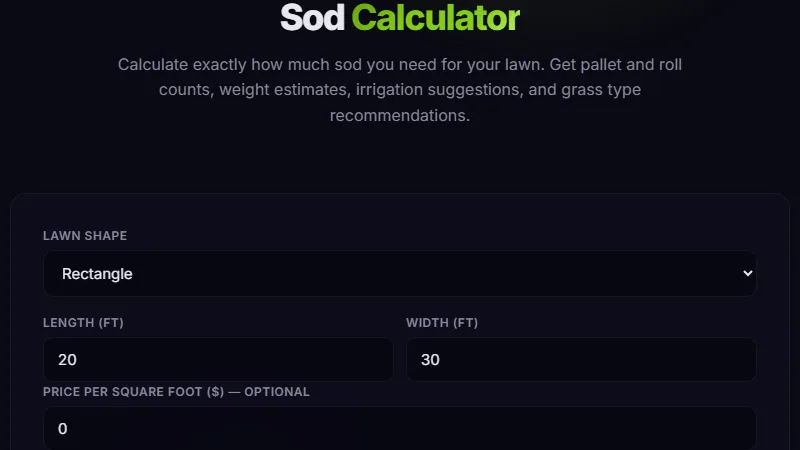
Subtract house footprint: 40x30 = 1,200 sq ft.
Subtract driveway: 10x20 = 200 sq ft.
Net lawn area: 2,600 sq ft.
At 450 sq ft per pallet: 5.78 pallets → order 6 pallets.
Waste 10%: 2,860 sq ft → 6.36 pallets → still order 6 with careful cutting.
Planning a Curved Front Lawn with Planting Beds
Elena is re-sodding her front yard. The main area is 40x60 feet. There is a circular flower bed with a 6-foot diameter in the center and a curved walkway that meanders through the lawn. She measures the walkway as a 3-foot-wide by 50-foot-long rectangle for approximation. The flower bed subtracts 28 square feet (pi times 3 squared). The main rectangle is 2,400 square feet. She adds 12 percent waste for the curves. The total is 2,688 square feet. At 500 square feet per pallet, she needs 5.4 pallets. She orders 6 and uses the extra for a patch in the backyard. Without the measurement, she would have guessed 4 pallets and been severely short.
Irrigation Zone Planning Alongside Sod Ordering
Marcus is installing both sod and an irrigation system. He needs to know the lawn area to design the sprinkler zones. Each zone covers about 300 square feet with standard rotary heads. The sod calculation gives him 3,200 square feet for the back lawn. He divides by 300 to get 10.7 zones, rounds to 11 sprinkler heads. He orders 7 pallets of sod at 480 square feet each. The two calculations cross-check each other: if the irrigation design and the sod order disagree significantly, one measurement is wrong. The tool helps him reconcile both before he spends money on either.
Limitations
The tool provides square footage based on your measurements. Pallet coverage varies by grower — always confirm the square footage per pallet with your supplier before ordering. Waste factors depend on lawn shape complexity, installer skill, and whether you are willing to piece together offcuts. Steep slopes may require sod staples and additional labor but not additional sod — though waste increases on slopes due to cutting.
The weight estimate assumes dry sod. Freshly harvested sod is heavy — a pallet can weigh 1,500 to 2,500 lbs. Make sure your driveway or delivery area can support the truck and the pallet drop. The tool cannot evaluate access constraints or soil conditions.
FAQ
How long can sod sit on a pallet before installation?
Ideally install within 24 hours of delivery. In cool weather, 48 hours is possible if the pallets are kept moist and shaded. Never let sod sit for more than 3 days — the heat generated by decomposing grass in the center of the pallet will kill the roots.
Should I order extra for the edges?
Yes. Add 5 to 10 percent extra for cutting and fitting around curves and obstacles. For rectangular lawns with minimal obstructions, 5 percent is enough. For complex shapes with trees, beds, and curved borders, use 10 to 15 percent.
Does the tool account for soil prep?
No. Soil volume for grading or topdressing is separate. If you need to add 2 inches of topsoil over the entire area, calculate that as length times width times 0.167 feet, divided by 27 to get cubic yards. The tool is for sod quantity only.
What is the difference between slabs and rolls?
Rolls are typically 2x5 feet (10 sq ft) and are lighter and easier to handle. Slabs are smaller pieces (16x24 inches is common) and are heavier per piece but cover irregular shapes with less waste. Both come on pallets. Ask your supplier which format they carry.
Can I use this for hydroseeding instead?
The area measurement is the same. Instead of pallets, hydroseeding is priced per square foot or per gallon of slurry. Use the tool to get the area, then ask your hydroseeding contractor for a price based on that square footage.
Conclusion
Use this approach when you are replacing an entire lawn or establishing new turf in a residential or commercial property. It bridges the gap between the irregular shape of your property and the standardized pallet sizes that suppliers deliver. Do not rely on it for golf course or sports field installations — those require laser grading and precision measurements beyond a standard area calculation. For the average homeowner installing a new lawn, it eliminates the two most common outcome: leftover sod and last-minute shortages.
If you are also pouring a concrete path or patio alongside the landscaping, the concrete calculator handles the hardscape volume. The square footage calculator is also useful for measuring irregular lawn sections before calculating sod needs.
← Back to Blog