Sleep Calculator — Best Bedtime Based on Sleep Cycles
What It Solves
You wake up groggy even after what felt like enough sleep. The problem is not how long you slept — it is when you woke up. Human sleep runs in 90-minute cycles. Waking mid-cycle, during deep slow-wave sleep, triggers sleep inertia that leaves you foggy for hours. This calculator solves that by telling you exactly when to go to bed or when to wake up based on complete cycle alignment. It also tracks sleep debt, includes a nap calculator, a chronotype quiz, and follows NSF age recommendations.
The Real Problem
Most people pick a bedtime based on when they feel tired, not based on cycle math. If you fall asleep at 11:30 PM and set an alarm for 6:30 AM, you wake exactly 30 minutes into a deep sleep cycle — right in the worst possible moment. You spend the first hour of your day fighting brain fog that coffee barely touches. The same person going to bed at 10:15 PM wakes after 5 full cycles at 6:30 AM and feels fine. The difference is not total sleep time but cycle alignment. Sleep debt complicates things further: if you lost 2 hours each night during the work week, you carry a 10-hour deficit into the weekend that no single lie-in can fix. The calculator handles all of this.
How to Use the Tool
Open the sleep calculator. You have two main modes. Mode one: enter your desired wake time and the tool suggests bedtimes in 90-minute increments (6 cycles = 9 hours, 5 cycles = 7.5 hours, 4 cycles = 6 hours) with 15 minutes added for falling asleep. Mode two: enter your bedtime and it shows recommended wake times. Below the main calculator, the nap section lets you enter a nap duration and warns if it will end in deep sleep (bad) or light sleep (good). The sleep debt tracker lets you log your actual sleep over a week and compares it to your target. The chronotype quiz asks 5 questions about your natural energy patterns and classifies you as a lark, owl, or intermediate.
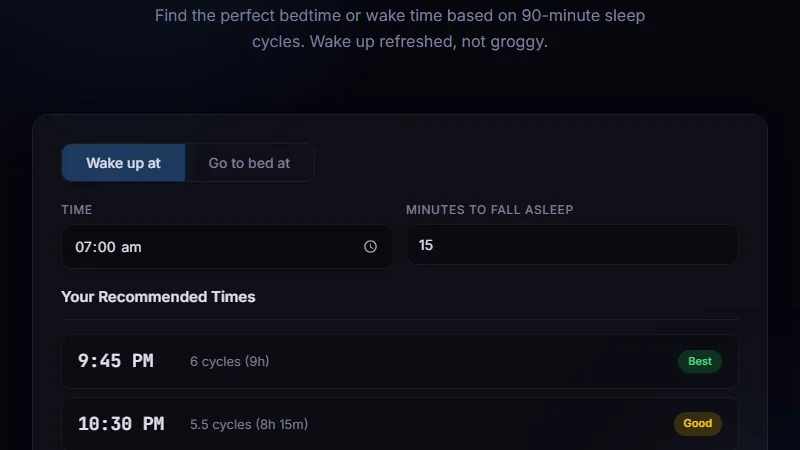
Optimal bedtimes (including 15 min to fall asleep):
6 cycles (9h sleep): 8:45 PM bedtime → wake at 6:30 AM refreshed.
5 cycles (7.5h sleep): 10:15 PM bedtime → wake at 6:30 AM refreshed.
4 cycles (6h sleep): 11:45 PM bedtime → wake at 6:30 AM, minimal grogginess.
Going to bed at 11:00 PM means you fall asleep around 11:15 and wake at 6:30 in the middle of cycle 5's deep sleep — classic groggy morning.
The Early-Morning Shift Worker Realigning Sleep
Carlos starts work at 4:30 AM at a distribution center. He was going to bed at 8 PM and waking at 3:45 AM — 7.75 hours, but always groggy. The calculator showed he was waking 45 minutes into his fifth cycle. By shifting his bedtime to 7:15 PM, he completed 5 full cycles (7.5 hours) ending right at his wake time. The 45-minute earlier bedtime felt extreme for the first week, but by day 10 he stopped needing his second alarm. He also used the sleep debt tracker and realized his weekend sleep schedule (midnight to 9 AM) was creating a cycle mismatch every Monday. He now keeps weekend bedtimes within an hour of his weekday schedule and reports dramatically better Monday mornings.
The College Student Using Chronotype Awareness
Aisha, a university student, took the chronotype quiz and discovered she was a strong evening type (owl). She had been forcing a 10 PM bedtime to match her 8 AM classes, but the calculator showed that her natural sleep phase wanted a midnight bedtime with an 8 AM wake (5 cycles). She restructured her schedule: stopped fighting her chronotype and shifted her study sessions to 10 PM-1 AM when she was most productive, with a midnight bedtime and 7:30 AM wake. Her GPA did not change much, but her subjective well-being improved dramatically — she stopped feeling like she was fighting her own body every day. The NSF age recommendation checker confirmed that 7.5 hours was within the healthy range for her age group.
Limitations
The 90-minute cycle is a population average; your actual cycle length could be anywhere from 70 to 120 minutes. The 15-minute fall-asleep buffer assumes average sleep latency — if you take 45 minutes to fall asleep, you need to adjust the proposed bedtimes accordingly. The sleep debt tracker relies on self-reported data, which tends to overestimate actual sleep time by 30-60 minutes per night. The chronotype quiz is a simplified classification and cannot replace a clinical assessment for circadian rhythm disorders. The calculator does not address sleep quality factors like apnea, restless legs, or environmental disturbances that affect rest regardless of cycle timing.
FAQ
Conclusion
Use this tool when you want to optimize your sleep schedule based on biology rather than habit. It is most useful for shift workers, new parents, people transitioning time zones, or anyone who wakes up feeling worse than when they went to bed. Do not use it as a substitute for medical advice if you suspect a sleep disorder. For tracking how long you actually sleep versus your target, the time duration calculator can help log your sleep hours accurately. And if you are curious about how your height and weight affect your health metrics, check the BMI calculator as a complementary tool.
← Back to Blog