Simple Interest — How to Calculate Interest on Loans and Investments
What It Solves
Simple interest answers the question: if I lend or borrow a sum of money at a given annual rate, how much interest will accrue over a specific period? Unlike compound interest where interest earns interest, simple interest only accrues on the original principal. This makes it straightforward to calculate and easy to understand, which is why it remains the standard for many short-term loans, car financing, and certain bonds.
The Real-World Problem
You take out a personal loan of $10,000 at 8 percent annual interest for 3 years. The bank tells you the total repayment will be $12,400. You want to verify that number. The simple interest formula is principal times rate times time. Ten thousand times 0.08 times 3 equals $2,400 in interest. Total repayment is $12,400. That checks out. But what if the loan is for 18 months? The time variable changes. Ten thousand times 0.08 times 1.5 equals $1,200. Total repayment is $11,200. The bank quotes $11,212. The difference of $12 is because the bank uses a 365-day count instead of a monthly approximation.
The confusion deepens when you compare loan offers. One lender offers 6 percent simple interest over 5 years. Another offers 5.5 percent with a $200 origination fee. Which is cheaper? Without calculating the total interest and comparing it to the fee, you cannot tell. The simple interest formula gives you the tools to make that comparison directly.
How to Use It
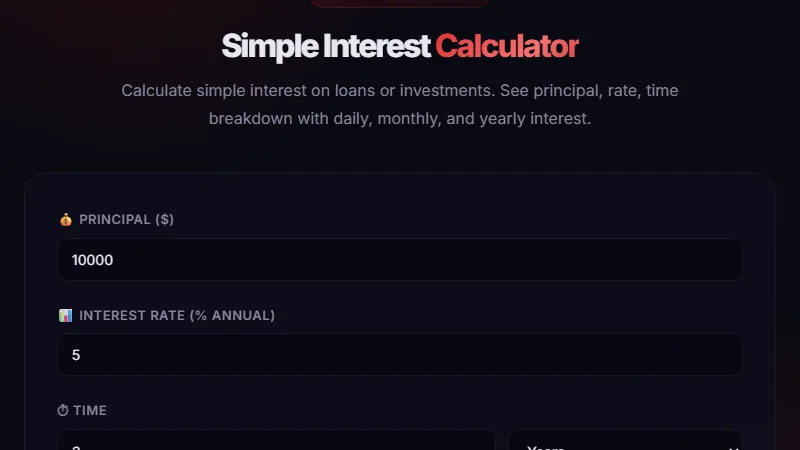
Enter the principal amount, the annual interest rate as a percentage, and the time period in years, months, or days. The tool calculates the total interest and the total amount (principal plus interest). For reverse calculations, enter any three values and the tool solves for the fourth. This is useful when you know the monthly payment you can afford and need to find the maximum loan amount or the effective interest rate.
Interest: $15,000 x 0.07 x 4 = $4,200.
Total: $19,200.
Monthly payment: $19,200 / 48 = $400 exactly.
Reverse: If you can pay $400/month for 48 months on a $15,000 loan, the rate is 7%.
Comparing Loan Offers with Different Terms
Anita is comparing two car loans. Loan A is $25,000 at 4.5 percent simple interest for 60 months. Loan B is the same $25,000 at 4 percent but with a $500 processing fee. She calculates Loan A interest: $25,000 times 0.045 times 5 equals $5,625. Total cost: $30,625. Loan B interest: $25,000 times 0.04 times 5 equals $5,000. Total with fee: $30,500. Loan B saves $125 despite the fee. Without the calculation, she would have chosen Loan A because of the lower fee.
Calculating Interest on a Short-Term Business Loan
Marcus needs $50,000 for 90 days to cover inventory before the holiday season. A lender offers 12 percent simple interest with no fees. The interest calculation: $50,000 times 0.12 times (90/365) equals $1,479.45. Total repayment is $51,479.45. Marcus compares this to a credit card cash advance at 22 percent APR with a 3 percent fee. The card advance would cost $50,000 times 0.22 times (90/365) equals $2,712.33 in interest, plus $1,500 in fees, totaling $4,212.33. The simple interest loan saves him $2,732.88. The calculation makes the decision obvious.
Limitations
Simple interest does not account for compounding. For long-term investments or loans where interest is reinvested or added to the principal, compound interest produces significantly different results. The tool also assumes a constant interest rate throughout the term — variable-rate loans require a different calculation method. For loans with monthly payments that reduce the principal (amortization), simple interest on the original principal overstates the actual interest paid because the principal decreases over time.
The day-count convention matters. Some loans use 30/360 (30-day months, 360-day years), others use actual/365, and some use actual/360. The tool defaults to actual/365 but supports switching. Always confirm the day-count convention with your lender for precise results.
FAQ
What is the difference between simple and compound interest?
Simple interest is calculated only on the original principal. Compound interest is calculated on the principal plus any accumulated interest from previous periods. For a $10,000 loan at 8 percent over 5 years, simple interest yields $4,000 total interest. Compounded annually, it yields $4,693 — nearly $700 more.
When is simple interest used instead of compound?
Simple interest is common for short-term loans (under one year), car loans, certain personal loans, and bonds that pay periodic interest without reinvestment. Compound interest is standard for savings accounts, mortgages, credit cards, and long-term investments.
How do I calculate the interest rate if I know the total cost?
Use the reverse calculation mode. Enter the principal, total interest paid, and the time period. The tool solves for the interest rate. For example, if you paid $600 in interest on a $5,000 loan over 2 years, the rate is 600 divided by (5,000 times 2) equals 0.06 or 6 percent.
Does simple interest use 360 or 365 days?
It depends on the lender and jurisdiction. Consumer loans in the United States typically use 365 days. Commercial loans and some mortgages use a 360-day convention. The tool allows you to choose. The difference on a $100,000 loan at 8 percent for one year is $100,000 times 0.08 times (5/365) equals about $109.59 more for the 360-day method.
Can I use simple interest for savings?
Most savings accounts use compound interest, not simple. However, some short-term certificates of deposit and certain bonds pay simple interest. If you are comparing a simple interest savings product to a compound interest one, the compound product will always yield more over the same term at the same rate.
Conclusion
Use simple interest for any loan or investment where the interest is paid periodically and not reinvested into the principal. It is the right tool for car loans, short-term business financing, personal loans with fixed terms, and bond yield calculations. Do not use it for mortgage comparisons, credit card debt, or retirement savings projections — those require compound interest calculations that account for interest on interest. For quick comparisons between loan offers with different rates and fees, it gives you the total cost figure you need to make an informed decision.
If you are evaluating long-term investments, the compound interest calculator provides a more accurate picture. For loan amortization schedules with monthly payments, the amortization calculator shows how each payment splits between principal and interest over time.
← Back to Blog