Salary vs Hourly — How to Compare Job Offers with PTO and Benefits
Comparing a salaried offer to an hourly one is not as simple as dividing by 2080. Paid time off, benefits, overtime eligibility, and tax treatment all affect the real value of each option. This post shows you how to make an apples-to-apples comparison so you can negotiate with confidence.
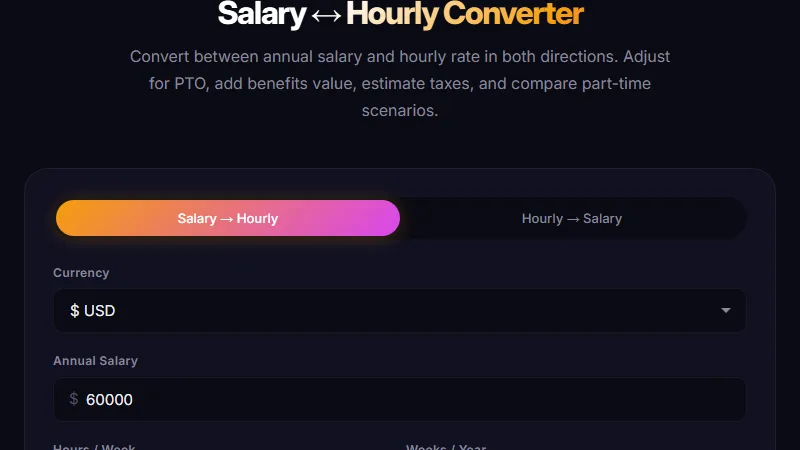
Why the Simple Division Is Misleading
The standard formula divides annual salary by 2080 hours (40 hours per week times 52 weeks) to get an hourly equivalent. A $75,000 salary divided by 2080 equals roughly $36.06 per hour. But this ignores a critical difference: salaried workers receive the same pay whether they work 35 hours or 50 hours in a week, while hourly workers get paid only for hours actually worked. The real comparison requires factoring in PTO, typical overtime, and schedule flexibility.
How PTO Affects the Comparison
A salaried employee with 15 days of PTO plus 10 holidays is paid for 2080 hours but works only 1880 hours. Their effective hourly rate based on hours worked is higher than the simple division suggests. For a $75,000 salary: $75,000 divided by 1880 hours actually worked equals $39.89 per hour, not $36.06. An hourly worker who takes the same time off without pay would earn significantly less unless their hourly rate compensates for the unpaid time.
Example Comparison
Job A: $75,000 salary, 15 days PTO, 10 holidays, 5 sick days. Hours worked: 1880. Effective hourly: $39.89.
Job B: $38.00 per hour, no PTO, no holidays. Working 1880 hours yields $71,440, which is $3,560 less than Job A. Even at $40.00 per hour, Job B pays $75,200 — only $200 more than Job A, with no paid time off.
Benefits Add Significant Value
Health insurance, retirement contributions, and other benefits add 25% to 40% above base salary in total compensation. A $75,000 salary with employer-paid health insurance worth $6,000 and a 5% 401k match worth $3,750 brings total compensation to $84,750. An hourly role offering the same benefits would need an equivalent total package. When comparing offers, ask for the total compensation breakdown including benefits value.
Overtime Eligibility
Hourly employees in the US are eligible for overtime at 1.5 times the base rate for hours over 40 per week. Salaried exempt employees receive no overtime pay regardless of hours worked. If your role regularly requires more than 40 hours, an hourly position with overtime can dramatically increase earnings. A $35 per hour role working 50 hours per week for 10 weeks per year would earn $5,250 in overtime premium alone.
Tax Implications Are Similar but Timing Differs
Both salary and hourly income are taxed as ordinary income at the same federal and state rates. The difference is in withholding. Salaried workers have predictable withholding throughout the year. Hourly workers with variable schedules may see fluctuating paychecks and need to adjust withholding accordingly. Self-employment taxes apply only to independent contractor roles, not W-2 hourly positions.
Limitations to Keep in Mind
The calculator provides hourly equivalents based on standard assumptions, but individual situations vary. Benefits value depends heavily on the specific employer plan. Overtime availability is not guaranteed in all hourly roles. Commission, bonuses, and equity are not included in the basic calculation. The tool is designed for comparing base pay structures, not total compensation packages that include variable pay.
Frequently Asked Questions
How many hours per year does a salaried employee work?
The standard assumption is 2080 hours (40 hours times 52 weeks). After subtracting typical PTO, holidays, and sick leave, actual hours worked range from 1800 to 1950 depending on the employer's leave policy.
Does the calculator account for overtime?
The calculator shows your hourly equivalent based on standard hours. Overtime is not factored into the hourly rate display, but you can manually add expected overtime hours to estimate your actual hourly effective rate.
Are salaried or hourly roles better for work-life balance?
It depends on the specific role. Salaried positions often have more flexibility with start and end times but may require longer hours without additional pay. Hourly roles have clearer boundaries but less schedule flexibility.
Should I include benefits when comparing offers?
Yes. Benefits add 25% to 40% to total compensation. An $80,000 salary with excellent benefits may be worth more than a $90,000 salary with minimal benefits. Always ask for a total compensation statement.
What is the standard work year assumption?
The standard is 2080 hours (40 hours per week times 52 weeks). The calculator uses this as the default but allows adjusting for PTO and holidays to reflect your actual working hours.
When to Use Each Pay Structure
Salary works best for roles with consistent responsibilities, managerial positions where results matter more than hours, and jobs that require occasional extra effort without additional compensation. Hourly pay is better for roles with variable schedules, positions where overtime is common and well-compensated, and situations where you need clear boundaries between work and personal time. Use the calculator to translate between the two and see the real difference PTO and benefits make.
Try the Salary to Hourly Calculator
Convert salary to hourly rates instantly with PTO adjustments and benefits considerations.
💵 Use the Calculator →