Pregnancy Due Dates — How LMP, Conception, and IVF Transfer Dates Are Calculated
What It Solves
You need to estimate when a baby will arrive. The due date calculator handles three different dating scenarios — last menstrual period, conception date, and IVF embryo transfer — because each requires a different calculation. LMP adds 280 days. Conception date adds 266 days. IVF transfers use the embryo age (day 3 or day 5) to back-calculate to a standard 40-week timeline. The tool gives you not just a single date but also a due window and milestone markers for each trimester.
The Real Problem
Due dates are wrong most of the time. Only about 5% of babies arrive on their exact due date. But the due date still matters for scheduling prenatal tests, planning maternity leave, and knowing when to head to the hospital. The confusion starts with the LMP method — it counts from the first day of your last period, which is about two weeks before conception. People who track ovulation know their actual conception date and get confused when the doctor's date does not match. IVF adds another layer because the embryo age changes the math. The calculator makes all three methods transparent.
How to Use It
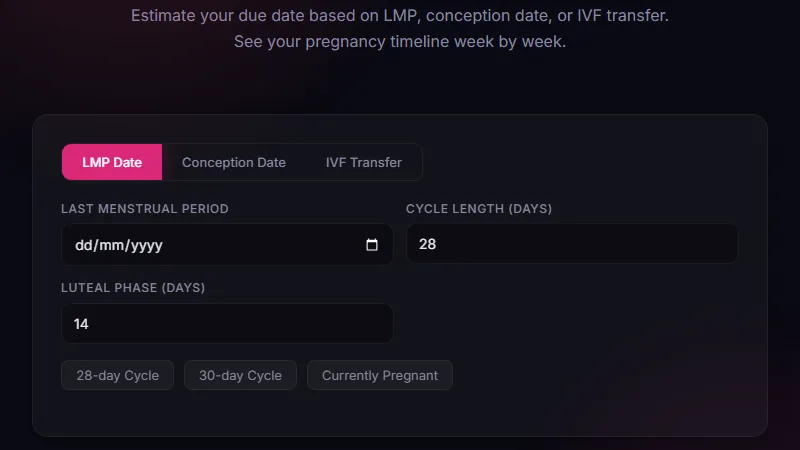
Open the due date calculator and select your dating method. For LMP: enter the first day of your last menstrual period. For conception: enter the date of ovulation or known conception. For IVF: enter the transfer date and whether it was a day 3 or day 5 embryo. The tool calculates the estimated due date, current gestational age in weeks and days, trimester milestones, and the statistically likely delivery window (38-42 weeks). Results include a week-by-week breakdown of fetal development milestones.
Due date: October 22, 2026. Conception estimate: January 29, 2026.
Window: October 8 - November 5, 2026 (68% probability).
Current at May 25: 18 weeks 5 days. Second trimester.
Planning Maternity Leave Around a Realistic Window
Sofia's employer needs 4 weeks notice for maternity leave. Her LMP was March 1. The calculator gives a due date of December 5. But the tool also shows the 38-42 week window: November 21 to December 19. Sofia gives her employer a start date of November 14 — two weeks before the window opens — to account for the possibility of early delivery. Without the window, she would have started leave on December 5 and potentially lost a week of pre-birth leave if the baby arrived early. The window saved her from an awkward phone call from the hospital.
Dating a Pregnancy After IVF With Known Transfer Date
Rachel had a day-5 blastocyst transfer on April 10. Her clinic told her she was "5 weeks pregnant" the next day, which confused her — the transfer just happened. The calculator explains why: IVF dating counts from the first day of a hypothetical LMP, which for a day-5 transfer is 19 days before the transfer. So April 10 transfer means an LMP estimate of March 22, putting her at 5 weeks 1 day on April 11. She enters the transfer date, selects "day 5," and the tool shows her due date as December 25. The transparent calculation removes the mystery of IVF pregnancy dating.
Limitations
All dating methods are estimates. The LMP method assumes a 28-day cycle with ovulation on day 14 — many women have longer or shorter cycles, which shifts the true due date by days or weeks. Irregular periods make LMP dating unreliable. Conception dating assumes you know the exact date of ovulation, which requires ovulation tracking. Even then, sperm can survive for up to 5 days, so the exact fertilization date may differ from the ovulation date by several days.
The calculator does not account for multiple pregnancies (twins, triplets), which typically deliver earlier than singletons. It also does not adjust for maternal age, BMI, or medical history — all factors that influence actual delivery timing. The due window (38-42 weeks) is population-based and may not apply to individual risk profiles. Always confirm gestational age with an ultrasound, especially in the first trimester.
FAQ
Why does the LMP method add 280 days when pregnancy is 266 days?
The 280-day count (40 weeks) starts from the first day of the LMP, which is about 14 days before ovulation. The actual pregnancy from conception to birth is approximately 266 days (38 weeks). The extra 14 days account for the pre-ovulation phase of the menstrual cycle.
How accurate is ultrasound dating compared to LMP?
First-trimester ultrasound (crown-rump length between 8-14 weeks) is the most accurate dating method, with a margin of 5-7 days. If ultrasound dating differs from LMP by more than 7 days in the first trimester, the ultrasound date is usually used for the official due date.
What does "due window" mean?
Only 5% of births occur exactly on the due date, but about 68% occur within a 4-week window around it (38-42 weeks). The window is more useful for planning than the single date. Use the window for leave planning, not the specific day.
Does the calculator work for irregular cycles?
The LMP method assumes a 28-day cycle. If your cycle is consistently longer or shorter, adjust accordingly — for a 35-day cycle, add 7 days to the LMP-based due date. For irregular cycles, first-trimester ultrasound is strongly recommended for accurate dating.
How do I calculate for an IVF pregnancy with a day-3 transfer?
For a day-3 embryo transfer, the hypothetical LMP is 17 days before the transfer (vs 19 days for day-5). The calculator handles this automatically when you select "day 3" as the transfer type. Day-3 transfers will have a due date 2 days earlier than a day-5 transfer with the same transfer date.
Conclusion
Use this tool when you need an initial due date estimate for any of the three common dating scenarios — LMP, conception, or IVF. It gives you a due date, a realistic delivery window, and trimester milestones in one view. Do not use it as a substitute for professional obstetric dating, especially for high-risk pregnancies or when ultrasound dating is available. The calculator is a planning tool, not a medical device. Confirm all dates with your healthcare provider. You may also find the date difference calculator useful for tracking weeks between appointments or milestones.
← Back to Blog