Resistors in Parallel and Series — How to Combine Any Number of Resistors
What It Solves
You have a handful of resistors and you need a specific resistance value you don't have in your drawer. Or you're designing a circuit that needs a precise voltage divider. Instead of ordering the exact value, you can combine what you have — in series, in parallel, or a mix of both — to get the number you need. The resistance calculator tells you the total resistance of any combination you enter.
The Real Problem
Resistors come in standard values: 10, 12, 15, 18, 22, 27, 33, 39, 47, 56, 68, 82, and their multiples. If you need 25 ohms, you can't buy a standard 25-ohm resistor at most suppliers. But put a 10-ohm and a 15-ohm resistor in series and you get 25 ohms exactly. If you need 8 ohms for a speaker crossover and you have 16-ohm resistors, two in parallel gives you 8 ohms. The math is straightforward for simple cases, but when you're combining three, four, or more resistors with different values, doing it by hand gets tedious and error-prone.
Tolerance makes it worse. A 100-ohm resistor with 5% tolerance could be anywhere from 95 to 105 ohms. When you combine several resistors, the tolerances stack. Two 100-ohm 5% resistors in series give you 190-210 ohms, not a clean 200 ohms. The total depends on which side of the tolerance each individual resistor falls on. The worst-case spread matters for sensitive circuits like precision voltage references or current sensing.
Here's a practical case. A hobbyist is building a current limiter for an LED strip and needs 3.3 ohms with at least 2W power rating. He has 1-ohm and 2.2-ohm resistors, all 1/4W. Putting three 1-ohm in series gives 3 ohms — close but not 3.3. Putting 2.2 and 1.1 (two 2.2 in parallel) in series gives 3.3 exactly. But the power dissipation: at 1A, the 2.2-ohm resistor dissipates 2.2W, way over its 0.25W rating. The calculator catches this because it shows the power each resistor sees.
How to Use It
Open the parallel resistance calculator. You can add any number of resistors in a list. For each one, enter the resistance value in ohms (use k and M suffixes for kilohms and megohms) and the power rating if you want power checks. The calculator instantly shows the total resistance. Toggle between series and parallel mode. In series, resistances add directly. In parallel, the total is the reciprocal of the sum of reciprocals. The tool also shows the current through each resistor for a given applied voltage and alerts you if any resistor exceeds its power rating.
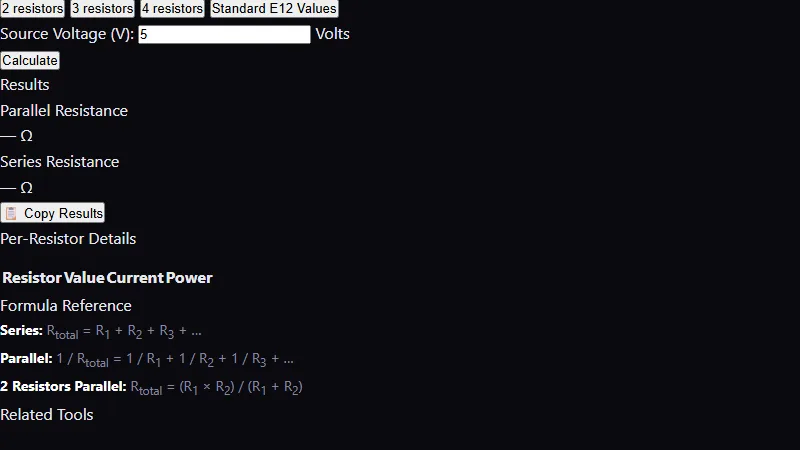
Config: Two 100-ohm resistors in parallel.
Result: Total resistance = 50 ohms. Each resistor sees half the current, so each dissipates half the total power. At 1W total, each dissipates 0.5W — exactly at their rating. Marginal but legal.
Better: Three 150-ohm resistors in parallel gives 50 ohms with each dissipating 0.33W — plenty of headroom.
Building a Precise Voltage Divider from Stock Values
Priya needs a voltage divider that takes 12V input and outputs 3.3V. The ratio is 3.3/12 = 0.275. She wants the divider to draw under 1mA from the source, so total resistance should be above 12k ohms. She picks R1 = 33k and R2 = 12k. The ratio is 12/(33+12) = 0.267 — close to 0.275 but not exact. The output would be 3.2V, which is within 3% but might not work for her ADC reference. She adds R3 = 150k in parallel with R2 using the calculator. Parallel combo: 12k || 150k = 11.11k. New ratio: 11.11/(33+11.11) = 0.252 — worse. She tries R1 = 27k and R2 = 10k: ratio = 10/(27+10) = 0.270, giving 3.24V. Close enough. The calculator lets her iterate combinations in seconds instead of doing the algebra each time.
Current Sharing in Parallel Power Resistors
A power supply design needs a 0.47-ohm sense resistor rated at 5W. Standard 0.47-ohm 5W resistors are expensive and hard to find. Instead, four 1.88-ohm 2W resistors in parallel give 0.47 ohms with a combined 8W rating. But if one resistor has a 5% tolerance, it could be 1.97 ohms while another is 1.79 ohms. The lower-resistance path carries more current. Worst case, one resistor carries about 28% more than its share, potentially hitting 2.56W in a 2W part. The calculator helps by showing current distribution across parallel branches given user-specified tolerances, so the designer can decide whether to hand-match or use a higher tolerance grade.
Limitations
The calculator assumes ideal resistors with the nominal value entered. It doesn't automatically model temperature coefficient or voltage coefficient unless you enter them. For precision circuits, the difference between nominal and real behavior matters. The power calculation assumes steady-state DC — transient power spikes in pulsed circuits are higher but brief, which the tool doesn't capture. And for AC circuits, impedance includes reactance from parasitic capacitance and inductance at high frequencies, but the tool is strictly resistive.
The calculator also doesn't enforce standard resistor values. It will happily tell you to use a 37.5-ohm resistor, but you can't buy that. You'll need to combine standard values or use a trim pot. The tool is for combining what you have, not for picking standard values from a series — though you can certainly use it to experiment with combinations of E12 or E24 values.
FAQ
What's the formula for parallel resistance?
The total resistance of resistors in parallel is 1 / (1/R1 + 1/R2 + ... + 1/Rn). For two resistors, a shortcut is (R1 x R2) / (R1 + R2). For equal-value resistors, divide the value by the number of resistors.
How does tolerance affect parallel combinations?
Worst-case tolerance stacks. For two 100-ohm 5% resistors in parallel, the nominal value is 50 ohms. But the worst-case low is two 95-ohm in parallel = 47.5 ohms, and worst-case high is two 105-ohm = 52.5 ohms. The actual parallel combo has a 5% spread, same as the individual parts.
Can I mix series and parallel in the same circuit?
Yes — this is called a series-parallel or mixed configuration. Solve the parallel groups first, then add the series portions. The calculator supports adding sub-groups so you don't have to reduce the network manually.
What happens if one resistor in parallel fails open?
Total resistance increases, which reduces total current. The remaining resistors carry more current individually. In a worst case, the increased current can cause a cascade failure. This is why parallel resistor banks in power circuits often use derating.
Does wire resistance matter in low-value circuits?
Yes. For resistances under 1 ohm, the resistance of the wires, solder joints, and PCB traces becomes significant. A 0.1-ohm sense resistor with 0.05 ohms of wiring adds 50% error. Use four-wire (Kelvin) connections for sub-ohm measurements.
Conclusion
Use the parallel resistance calculator whenever you're combining standard resistor values to hit a non-standard target, checking power distribution in parallel banks, or designing voltage dividers from stock parts. It's also useful for quickly calculating equivalent resistance for LED current-limiting resistors or pull-up/pull-down networks. Don't use it as a substitute for SPICE simulation when frequency-dependent effects matter, or when precision beyond 1% is needed without considering real component tolerances. For basic breadboard work and repair, it's faster and more accurate than mental math.
If you're working with battery packs in series-parallel configurations, the battery life calculator covers similar combination math for capacity and voltage.
← Back to Blog