How Much Paint Do You Actually Need? — A Practical Guide to Not Wasting Money on Extra Gallons
What It Solves
You're painting a room and you need to know how many gallons to buy. Buy too little and you're driving back to the store hoping the tint machine still has the formula. Buy too much and you've got five gallons of "eggshell antique white" sitting in your basement forever. The paint coverage calculator gives you a number based on your actual wall area, not a rule of thumb.
The Real Problem
Paint cans say "one gallon covers 350-400 square feet." That's on a perfectly smooth, primed wall with no windows or doors. Real rooms have windows, doors, baseboards, and sometimes textured walls that soak up more paint. A typical 12x12 bedroom with 8-foot ceilings has about 384 square feet of wall area — right at the edge of that one-gallon claim. But subtract a standard door (21 sq ft) and a window (15 sq ft) and you're at 348 sq ft. That one-gallon can will barely make it through one coat. If you're doing two coats — and you should be — you need two gallons minimum.
The mistake most people make is estimating by room size alone. "It's a small bedroom, one gallon should do it." Then they run out at 11 PM on a Sunday with half a wall left. The tool prevents this by actually doing the subtraction.
How to Use It
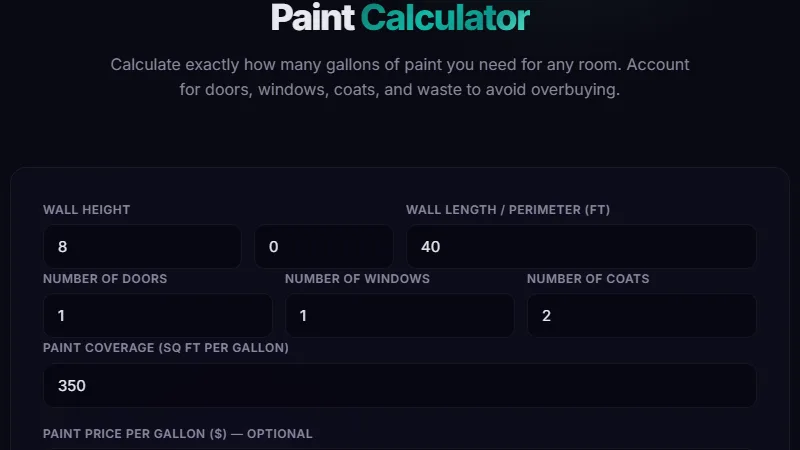
Open the paint calculator. Start with wall height and the perimeter of the room. For a standard rectangular room, that's just (length + width) x 2. If you're painting an accent wall, you can enter its width directly. Add the number of doors and windows — the tool subtracts their areas automatically. Choose how many coats. Set the waste factor to 10% if you're rolling (standard) or 15% if you're cutting in with a brush (more waste). The result shows gallons and quarts.
Should I include ceiling paint?
No — the tool calculates wall paint only. Ceilings are a separate job and typically use flat paint. To estimate ceiling paint, multiply length by width of the room and divide by 350 (one gallon covers about 350 sq ft on ceilings).
Do I need primer in the calculation?
Primer is separate. One gallon of primer covers about 300 sq ft. If you're painting over a darker color or new drywall, add a primer coat before your paint coats. The tool doesn't include primer — it's a separate calculation.
What about trim and baseboards?
Trim paint is different from wall paint (semi-gloss vs eggshell). The tool is for wall area only. Baseboards add about 10-20 sq ft per room — not enough to change your gallon count, but worth knowing for ordering trim paint separately.
Can I use the same tool for exterior painting?
The math works the same, but exterior surfaces often require more paint due to texture (stucco, brick, wood siding). Reduce coverage to 250 sq ft per gallon for rough surfaces and add an extra coat for exterior-grade durability.
Why do I need two coats?
One coat rarely provides even coverage, especially with lighter colors over darker walls. Two coats ensure color uniformity, better durability, and washability. The formula assumes two coats by default for a reason.
Conclusion
Use this tool when you're buying paint for any room refresh or full-house project. It saves you from buying too much (wasted money) or too little (wasted time). Don't use it for stain, varnish, or specialty coatings — those have different coverage rates. For those, check the manufacturer's specs and apply the same area-calculation principle manually.
If you're also doing flooring, the flooring calculator follows the same logic for estimating tiles or hardwood — and the square footage calculator can help you measure oddly shaped rooms before you paint or floor them.
← Back to Blog