Overtime Pay — How to Calculate Time and a Half and Double Time
What It Solves
An employee works 47 hours in a week at $22 per hour. Their regular pay for 40 hours is $880. The remaining 7 hours are overtime at 1.5x the rate — $33 per hour — adding $231. Total gross pay: $1,111. That's simple enough, but what happens when the hourly rate changes mid-week? Or when the employee worked different rates for different tasks (a $22 rate for regular duties and a $25 rate for specialized work)? What about double time on holidays or Sundays? The tool handles all these scenarios by separating regular hours from overtime hours, applying the correct multiplier, and summing the gross pay.
The Real Problem
Under the Fair Labor Standards Act (FLSA), non-exempt employees in the US must be paid 1.5 times their regular rate for hours worked beyond 40 in a workweek. The key phrase is "regular rate" — it's not simply the base hourly rate. The regular rate includes nondiscretionary bonuses, shift differentials, and commissions earned during that week, divided by total hours worked. Most employees and many employers don't know this. They calculate overtime using the base rate alone, which can result in underpayment. For example, an employee earning $20/hour plus a $100 productivity bonus in a 45-hour week has a regular rate of ($900 + $100) / 45 = $22.22. Overtime should be $22.22 x 1.5 = $33.33 for 5 hours, not $20 x 1.5 = $30. The difference is $16.65 in that week alone.
The tool simplifies this by separating the two components: you enter the base rate and any additional earnings that factor into the regular rate calculation. The output shows the true overtime liability. For salaried non-exempt employees, the tool also calculates the equivalent hourly rate (salary divided by 40) and applies the same overtime logic. This is especially important because misclassified employees are one of the most common FLSA violations.
How to Use It
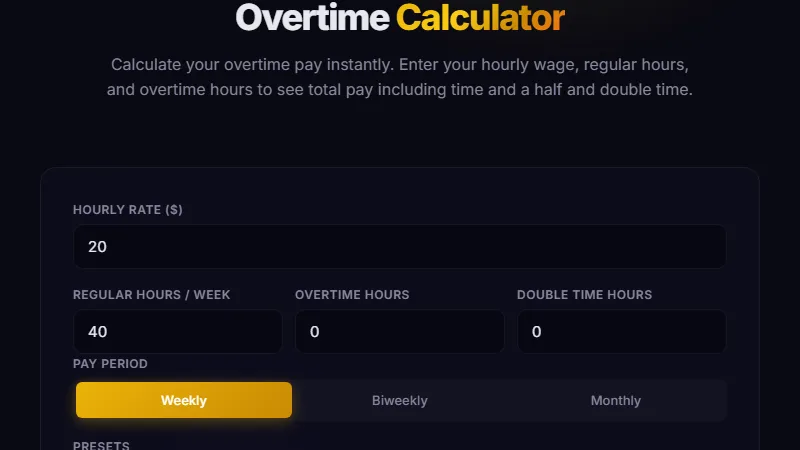
Enter the regular hourly rate. Enter the total hours worked for the week. The tool automatically separates the first 40 hours as regular time and the remainder as overtime at 1.5x. If your jurisdiction requires double time (2x) after a certain threshold — for example, after 12 hours in a day in California — switch to the "double time" option and set the threshold. Enter any bonus, commission, or shift differential earned in the same week, and the tool recalculates the regular rate. The output shows gross pay: regular wages, overtime wages, and the total.
Regular rate: ($18 x 50 + $75) / 50 = $19.50/hour.
Regular pay (40 hours): 40 x $19.50 = $780.
Overtime pay (10 hours): 10 x $19.50 x 1.5 = $292.50.
Total gross pay: $1,072.50.
Using base rate only would give $18 x 40 + $18 x 1.5 x 10 = $990. The bonus added $82.50 in overtime liability.
Daily Overtime and Double Time for California and Other States
Most US states follow the federal FLSA standard of overtime after 40 hours in a week. But California, Alaska, Nevada, and a few others have additional daily overtime requirements. In California, any hours beyond 8 in a single day are overtime at 1.5x, and hours beyond 12 in a single day are double time. Seven consecutive days of work in a workweek also trigger double time after 8 hours on the seventh day. The tool includes a state-specific mode that applies these rules when selected. A construction worker in Los Angeles who works 10 hours on Monday, 14 on Tuesday, and 8 on Wednesday has daily overtime on Monday (2 hours at 1.5x), daily overtime on Tuesday (4 hours at 1.5x + 2 hours at 2x), and no overtime on Wednesday. Without the daily overtime mode, only the weekly total of 32 hours would show no overtime at all. The tool catches this.
Salary-to-Hourly Conversion for Non-Exempt Salaried Employees
Some employees are salaried but still non-exempt, meaning they're entitled to overtime. Converting a salary to an equivalent hourly rate is the first step. A salaried non-exempt employee earning $52,000 per year has a weekly salary of $1,000 and an equivalent hourly rate of $25 (assuming a 40-hour week). If they work 48 hours in a week, the overtime is calculated on that $25 rate: 8 hours at $37.50 = $300, plus the $1,000 salary = $1,300 gross for the week. But careful — if the salary is meant to cover fewer than 40 hours (some agreements specify a 35-hour work week), the regular rate changes. The tool accepts weekly salary and expected hours per week to compute the correct equivalent hourly rate. This prevents the common mistake of calculating overtime on a straight salary without converting to an hourly equivalent first.
Limitations
The tool calculates gross overtime pay but does not deduct taxes, Social Security, Medicare, or other withholdings. It assumes a single workweek; for biweekly pay periods, divide the total hours by 2 before entering. The tool does not handle comp time (compensatory time off in lieu of overtime) — comp time policies vary by employer and public vs private sector rules differ significantly. The state-specific overtime rules cover only California and a subset of states with daily overtime; other states may have unique rules not included. Federal contractors may have additional overtime requirements under the Davis-Bacon Act or Service Contract Act that are not reflected in the tool. Always consult your state labor department or a payroll professional for jurisdiction-specific compliance.
FAQ
What is the difference between time and a half and double time?
Time and a half (1.5x) is the standard overtime rate for hours over 40 in a week, or over 8 in a day in states with daily overtime. Double time (2x) is required in some states after 12 hours in a day, or for the seventh consecutive workday over 8 hours. Federal law only requires 1.5x; double time is a state-level requirement.
How do bonuses affect overtime calculations?
Nondiscretionary bonuses (production bonuses, attendance bonuses, commissions) must be included in the regular rate before calculating overtime. Divide the total weekly compensation (including bonus) by total hours worked to find the regular rate, then multiply by 1.5 for overtime hours. Discretionary bonuses (unexpected gifts, holiday bonuses) are usually excluded.
Is overtime calculated weekly or daily?
Federal law (FLSA) uses a weekly standard — overtime is due after 40 hours in a workweek. Some states add a daily standard — overtime after 8 hours in a day (California, for example). The tool includes both modes. The workweek is defined by the employer and can start any day; the tool assumes a Monday-to-Sunday week unless you specify otherwise.
What is the overtime rate for salaried employees?
Non-exempt salaried employees must be paid overtime. To calculate, divide the weekly salary by the number of hours the salary is intended to cover (usually 40) to get the equivalent hourly rate, then apply the overtime multiplier. Exempt salaried employees are not entitled to overtime — they meet specific salary and duty tests under FLSA.
Do I pay overtime on holidays?
Federal law does not require extra pay for working on holidays (it's not a separate category under FLSA). However, many employers offer holiday pay as a benefit — often 1.5x or 2x for hours worked on a holiday. The tool's double-time option can be used to model this, but holiday pay policies are contractual, not statutory in most states.
Conclusion
Use this tool when you need to calculate gross overtime pay for hourly or salaried non-exempt employees, especially when bonuses, shift differentials, or state-specific daily overtime rules apply. It's most valuable for payroll accuracy — preventing both underpayment (which risks DOL penalties) and overpayment (which costs the business). Don't use it as a substitute for professional payroll software or a full-service payroll provider. The tool does not handle tax withholdings, multi-state employment, or collective bargaining agreement overtime terms. For precise compliance, consult a labor attorney or your state's labor department. The FLSA penalties for willful overtime violations can reach $2,074 per violation plus back wages and liquidated damages — making accurate calculation worth the effort.
If you need to track actual hours worked including breaks and lunch periods, the time duration calculator helps log daily hours, and the salary to hourly converter helps determine equivalent rates for salaried positions.
← Back to Blog