Meal Prep Macro Planning — How to Distribute Your Daily Protein, Carbs, and Fat Across Meals
1. Introduction
If you track your macros, you already know your daily targets for protein, carbohydrates, and fat. But knowing the big-picture numbers is only half the equation. How you distribute those macros across your meals can determine whether you feel energised throughout the day, stay full between meals, and build or maintain muscle effectively.
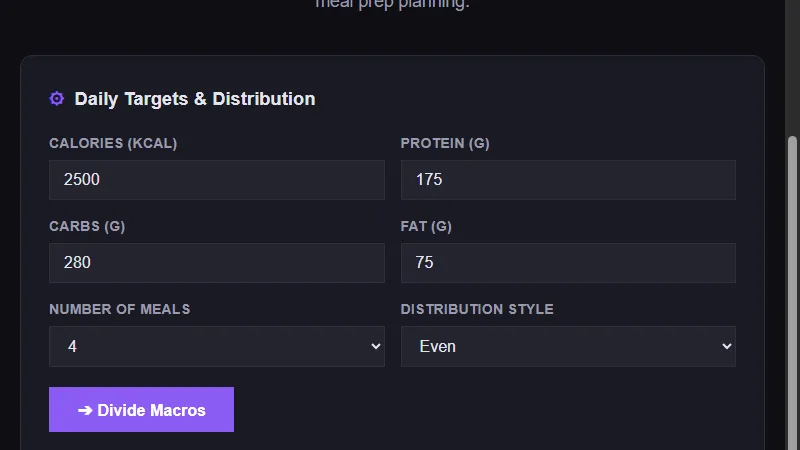
Meal prep macro planning is the bridge between abstract daily numbers and real, actionable meals. Instead of guessing how much to put in each container, you can use a structured approach — or a simple meal prep macro divider tool — to split your targets evenly (or strategically) across any number of meals. This article walks through the why, the how, and the practical steps to get it right.
2. Understanding Your Daily Macros
Before you can distribute macros, you need to know what each one does and how to set your targets.
Protein supports muscle repair, enzyme production, and satiety. A common starting point for active individuals is 1.6–2.2 g per kg of body weight. Carbohydrates provide the primary fuel for your brain and muscles. Intake can vary widely based on activity level, from 3–6 g per kg for moderate exercise up to 8–12 g per kg for endurance athletes. Fat supports hormone production, vitamin absorption, and cell health. Most people do well with 0.8–1.2 g per kg, or roughly 20–35 % of total calories.
Your total daily energy expenditure (TDEE) sets your calorie target. From there, allocate protein first (it's the most structure-critical macro), then carbs and fat based on your preferences and activity demands. Once you have your daily numbers — say 180 g protein, 220 g carbs, 65 g fat — the question becomes: how do you spread those across breakfast, lunch, dinner, and snacks?
3. Why Distribution Patterns Matter
Eating the same total macros in different patterns can produce noticeably different outcomes. Here is why distribution deserves as much attention as your daily totals.
Energy levels throughout the day are directly tied to when you eat carbohydrates. A carb-heavy breakfast can power a morning workout, while a carb-light evening meal can help some people sleep better. Matching your carb intake to your energy demand window keeps you steady rather than riding the blood-sugar roller coaster.
Muscle protein synthesis (MPS) responds to protein intake in a dose-dependent way, but only up to a point. Research suggests that 0.4–0.55 g per kg of protein per meal maximally stimulates MPS in most people. Spreading protein across three or four meals therefore yields better muscle-building results than compressing it into one or two large servings.
Satiety also benefits from distribution. A meal with at least 30–40 g of protein together with fibre from carbs and some fat tends to keep you full for 4–5 hours. Spreading this pattern across the day prevents the extreme hunger that can derail even the best meal prep.
4. Popular Distribution Strategies
There is no single "best" way to divide your macros, but several evidence-backed patterns have emerged. Here are the most common approaches.
Balanced (even split). Divide your daily protein, carbs, and fat as evenly as possible across all meals. For a 4-meal plan, each meal gets roughly 25 % of every macro. This is simple to prep, easy to track, and works well for most people. It keeps energy and satiety consistent from morning to night.
Front-loaded (bigger breakfast). Place a larger share of carbs and calories early in the day, tapering toward dinner. Proponents argue this aligns with the body's circadian insulin sensitivity and provides fuel when you need it most. A typical split might be 35 % breakfast, 30 % lunch, 25 % dinner, 10 % snack.
Back-loaded (bigger dinner). The reverse: a lighter breakfast and lunch with the largest meal in the evening. This suits people who train after work, have larger social dinners, or simply feel hungriest at night. Protein is still distributed evenly to support MPS, but carbs and calories skew toward the later hours.
16:8 intermittent fasting approach. Compress all meals into an 8-hour eating window (e.g. 12 pm – 8 pm). Macros are divided between 2–3 meals within that window. This approach naturally front-loads or back-loads depending on when you break your fast. It can simplify meal prep — fewer meals — but requires careful protein distribution to maintain MPS across the feeding period.
5. How Many Meals Should You Eat?
The old advice that "eating 6 small meals a day stokes your metabolism" has been largely debunked. Total daily energy expenditure is determined by calories consumed and activity performed, not meal frequency. So what does matter?
3 meals a day works perfectly well if each meal contains adequate protein (30–50 g) and you are comfortable with the portion sizes. It is the most practical approach for meal prep: three containers, three cooking sessions per week. Many people find it easier to adhere to three satisfying meals than to graze on six small plates.
4–5 smaller meals can be helpful if you have a small appetite, prefer lighter eating, or want a snack before or after training. The research shows no metabolic advantage, but individual preference matters. If four meals keeps you from overeating at dinner or helps you hit your protein target more comfortably, it is the right choice for you.
From a meal prep standpoint, 3–4 meals per day is the sweet spot. Each container can hold a complete, macro-balanced meal, and you avoid the overhead of portioning tiny snacks.
6. Meal Prep Efficiency
Efficient meal prep is about minimising cooking time while maximising macro accuracy. Here are the key strategies.
Cooking in bulk. Pick two or three protein sources (chicken breast, lean beef, tofu), two carb sources (rice, sweet potato), and two veggie or fat sources. Cook each in large batches, then assemble your meals. This reduces cleanup and decision fatigue.
Portioning macros per container. Use your daily targets divided by the number of meals to determine what each container should hold. For example, if your daily target is 180 g protein across 4 meals, each container needs 45 g protein. Weigh your cooked ingredients once and divide evenly — or use a macro divider tool to get exact per-meal numbers.
Batch cooking strategies. Cook once, eat 3–4 days. Most cooked proteins and grains hold well in the fridge for 4–5 days. Freeze portions beyond that. Invest in a food scale and a set of sturdy containers with compartments to keep macros separate until you are ready to eat.
7. Sample Meal Plans
Below is a 2000-calorie, 4-meal balanced plan. Each meal provides roughly 25 % of the day's protein, carbs, and fat — a simple template you can adjust to your own targets.
- Meal 1 (breakfast): 40 g protein, 50 g carbs, 17 g fat — scrambled eggs (3 whole + 3 whites), 80 g oats, 1 tbsp olive oil
- Meal 2 (lunch): 40 g protein, 50 g carbs, 17 g fat — 170 g chicken breast, 200 g sweet potato, 100 g avocado
- Meal 3 (dinner): 40 g protein, 50 g carbs, 17 g fat — 170 g lean beef, 200 g cooked rice, broccoli with 1 tbsp butter
- Meal 4 (snack): 40 g protein, 50 g carbs, 17 g fat — 1 scoop whey + 250 ml milk, 100 g banana, 30 g almonds
Daily totals: 160 g protein, 200 g carbs, 68 g fat — approximately 1992 calories. Adjust portion sizes up or down to match your own targets.
8. Conclusion
Your daily macro totals give you the destination, but distribution is the route you take to get there. Whether you choose a balanced split, a front-loaded pattern, or an intermittent fasting schedule, the key is to match your macro distribution to your lifestyle, energy needs, and meal prep workflow.
By planning how much protein, carbs, and fat go into each meal — rather than winging it — you set yourself up for consistent energy, better body composition results, and a fridge full of containers that actually support your goals. If you want to skip the manual math, try the Meal Prep Macro Divider tool: enter your daily targets and number of meals, and it will calculate the per-meal breakdown for you.