Calculating Your Macros — Protein, Carbs, and Fat for Any Fitness Goal
What It Solves
You know you should track what you eat, but you do not know what numbers to aim for. Calories alone are not enough — 200 calories of chicken breast affects your body differently than 200 calories of olive oil. Macronutrients — protein, carbohydrates, and fat — each play distinct roles. The problem is figuring out how many grams of each you personally need based on your weight, height, age, activity level, and whether you want to lose, maintain, or gain weight. A macro calculator removes the guesswork by applying evidence-based formulas to your specific inputs.
The Real Problem
Generic advice like "eat 0.8 grams of protein per pound of body weight" works for some people but not others. A 150-pound sedentary woman has different needs from a 200-pound powerlifter. But most people do not know how activity level changes the equation, or that carbohydrate needs shift depending on whether you are cutting or bulking. Without personalization, you either under-eat protein (losing muscle while losing fat) or over-eat carbs (storing more fat than necessary).
There is also the issue of fat ratios. Dietary fat is essential for hormone production, but too much pushes you past your calorie target. Too little and your energy levels drop. A good macro split balances all three while keeping total calories aligned with your goal. The calculator handles that balance automatically.
How to Use It
Open the macro calculator and enter your age, gender, height, weight, and activity level. Select your goal — lose weight, maintain, or gain weight. The tool calculates your basal metabolic rate using the Mifflin-St Jeor equation, applies an activity multiplier to get total daily energy expenditure, then adjusts calories for your goal. From there it applies a macro split: typically 30-40% protein, 30-50% carbs, and 20-30% fat depending on your goal and activity. The results show grams of each macro per day.
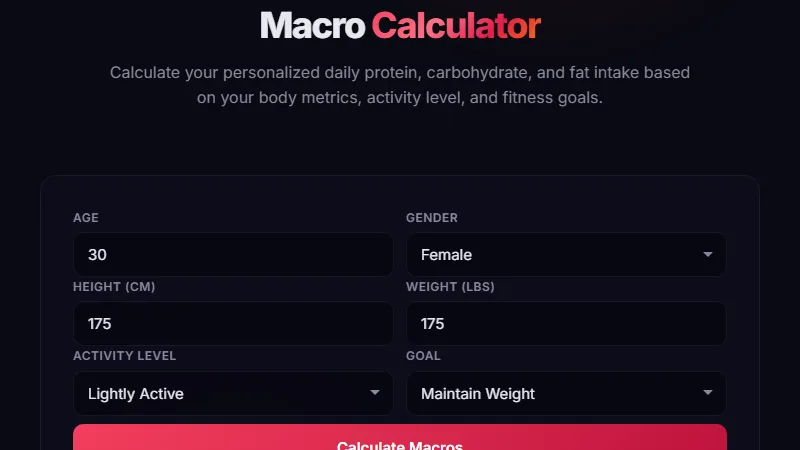
BMR: 1,850 kcal. TDEE: 2,870 kcal. Deficit: 2,370 kcal.
Protein: 180g (30%). Carbs: 237g (40%). Fat: 79g (30%).
That is a 40/40/30 split by calorie percentage. The protein matches body weight, which supports muscle retention during a cut.
Setting Up a Bulking Phase the Right Way
James is a 24-year-old who has been lifting for three years. He wants to add lean mass without gaining excessive fat. He enters his stats into the tool with a "gain weight" goal and a +300 calorie surplus. The tool recommends 2,930 calories with 195g protein, 390g carbs, and 72g fat. The high carb allocation supports training intensity — glycogen fuels his workouts. Over 12 weeks he gains 8 pounds, most of it lean. The structured split prevents the common mistake of "eating everything" during a bulk, which usually results in as much fat as muscle.
Adjusting Macros for a Sedentary Office Worker
Priya is a 40-year-old accountant who sits 9 hours a day. She wants to lose 15 pounds. Her maintenance calories are only 1,900. A standard macro split would give her 130g protein, 190g carbs, and 63g fat at a 15% deficit. The tool shows that even a small surplus of carbs pushes her past her calorie limit. She shifts to a lower-carb split — 140g protein, 160g carbs, 65g fat — which keeps her full while staying within 1,615 calories. After 8 weeks she loses 11 pounds without feeling deprived.
Limitations
Macro calculators provide starting points, not perfect targets. Individual factors like metabolic adaptations, gut microbiome, and hormonal differences mean the same numbers work differently for different people. The activity level selection is subjective — "moderately active" means different things to a construction worker and a desk worker who does 3 workouts a week. You should use the output as a baseline and adjust based on real-world results after 2-3 weeks.
The tool also does not account for meal timing, nutrient density, or food quality. 180 grams of protein from whole foods is not the same as 180 grams from protein powder and processed bars. Micronutrients, fiber, and hydration all affect how your body uses macros. The calculator handles the numbers; you handle the food choices.
FAQ
Do I need to track macros forever?
No. Most people track for 4-8 weeks to learn portion sizes and understand what foods fit their targets. After that, many switch to intuitive eating with occasional check-ins to stay on track.
What happens if I go over fat but under carbs?
As long as total calories stay on target, minor macro imbalances are fine. Consistent large deviations (e.g., always under-eating protein) will affect results. Prioritize hitting protein first, then split the rest between carbs and fat based on preference.
Can I use this if I am vegetarian or vegan?
Yes. The macro targets are the same. You just need to choose plant-based protein sources — tofu, tempeh, seitan, lentils, and legumes. You may need slightly more total protein since plant proteins have lower bioavailability.
Should I eat back exercise calories?
Generally no. The activity multiplier already accounts for your typical exercise. Eating back calories from individual workouts often leads to overeating. Trust the TDEE estimate and adjust after 2-3 weeks if weight is not moving as expected.
Conclusion
Use this tool when you are starting a new fitness phase — cutting, maintaining, or bulking — and need a structured starting point. It gives you science-backed numbers in seconds instead of guessing from generic charts. Do not use it as a rigid prescription. Treat the output as a hypothesis, track your results, and adjust. If you want to dial in your calories first before worrying about macro splits, start with the calorie calculator — it gives you TDEE and deficit/surplus targets directly.
← Back to Blog