How to Compare Job Offers — A Complete Guide to Evaluating Total Compensation
1. Introduction
When a new job offer lands in your inbox, it's tempting to glance at the base salary and make a snap decision. If Offer A says $110,000 and Offer B says $120,000, the math seems obvious — take the higher number. But that instinct can cost you tens of thousands of dollars over the life of your career.
Base salary is just one piece of the puzzle. Bonuses, retirement matching, paid time off, commuting costs, health insurance premiums, and equity all contribute to what you actually take home — and what your life looks like day to day. A $10,000 salary gap can vanish (or reverse) once you account for a stronger 401k match, better PTO, or a shorter commute.
This guide walks through each component of a job offer so you can evaluate the total compensation package rather than just the headline number. Whether you're deciding between two offers or negotiating to improve one, these frameworks will help you make a confident, data-driven decision.
2. Base Salary and Bonus
Base salary is the foundation, but don't stop there. Many companies offer additional cash compensation that can meaningfully change the picture.
Signing bonuses are one-time payments often used to bridge a gap or buy out forfeited compensation from a current employer. Spread the signing bonus over the expected tenure (say two to four years) to get an annualized value. A $10,000 signing bonus over two years adds $5,000 per year.
Annual performance bonuses are typically expressed as a percentage of base salary — for example, "10% target bonus." That means you can expect $11,000 on top of a $110,000 salary if the company and you meet performance goals. Be sure to ask about the historical payout rate; some companies consistently pay above target, while others rarely hit it.
Commission structures matter most in sales roles. Look at the OTE (on-target earnings) and what percentage of reps actually hit quota. A high OTE with a low attainment rate is less valuable than a modest OTE with reliable payouts.
When comparing, add base salary plus the realistic annualized value of bonuses and commissions to get your expected cash compensation.
3. 401k and Retirement Benefits
Employer retirement matching is effectively free money, yet it's one of the most overlooked elements in offer comparisons. A 5% match on a $100,000 salary puts an extra $5,000 per year into your retirement account. Over a decade, that grows to well over $70,000 with compound returns.
Key details to check: the vesting schedule (how long until the money is yours), the match formula (dollar-for-dollar vs. 50 cents per dollar), and the cap (some matches stop at a percentage of salary). Also look for after-tax Roth options, mega backdoor Roth capabilities, and whether the plan offers low-cost index funds. A generous match at a company with strong vesting and good fund options is a major long-term wealth builder.
4. PTO and Flexibility
Paid time off has a direct dollar value. Calculate your daily rate by dividing your annual salary by 260 (the typical number of working days per year). Then multiply by the difference in PTO days between offers.
For example, at $110,000 your daily rate is about $423. Fifteen PTO days are worth $6,346; ten PTO days are worth $4,231. The five-day gap is worth $2,115 in compensation value. Add in sick days and holidays — some companies bundle these into a combined PTO bank while others keep them separate.
Beyond raw PTO count, consider flexibility. Remote or hybrid work saves commuting time, reduces wardrobe and meal costs, and can improve quality of life. A role that allows you to work from home two days per week saves roughly $2,000–$4,000 per year in commuting and related expenses. While harder to quantify, flexibility is real value.
5. Commute Cost Impact
Commuting costs eat into your effective salary in ways that are easy to underestimate. The IRS mileage reimbursement rate (65.5 cents per mile in 2026) is a good proxy for the true per-mile cost of driving, including gas, maintenance, depreciation, and insurance.
To calculate your annual commute cost: multiply your round-trip commute distance by the IRS rate, then multiply by the number of working days per year (roughly 240 after accounting for PTO and holidays).
Don't forget parking fees, tolls, public transit passes, and the intangible cost of 30–60 minutes of daily windshield time. If one offer is fully remote, factor in the full commuting cost of the in-office role as a discount to that offer's compensation.
6. Health Insurance and Other Benefits
Health insurance premiums vary widely between employers. A high-premium plan can cost $300–$600 per month for a family, while a heavily subsidized plan might cost $100–$200. That's a difference of $1,200–$4,800 per year. Always request the Summary of Benefits and compare the annual premium, deductible, out-of-pocket maximum, and copay structure.
HSA contributions are another form of tax-advantaged compensation. Some employers contribute $500–$1,000 annually to your Health Savings Account. This money grows tax-free and can be invested — it's essentially a second retirement account.
Stock options and RSUs can be a significant portion of total compensation, especially at tech companies. For RSUs, look at the annualized vesting value (total grant divided by vesting years). For stock options, the value is less certain; consider the company's stage, liquidity, and your confidence in its growth.
Other benefits to inventory: tuition reimbursement, student loan repayment assistance, gym or wellness stipends, parental leave, professional development budgets, and sabbatical policies. Each adds real (if sometimes modest) value to your total package.
7. Side-by-Side Comparison Example
Let's put it all together with a realistic scenario. You're deciding between two offers:
| Component | Offer A | Offer B |
|---|---|---|
| Base Salary | $110,000 | $120,000 |
| Annual Bonus (target) | $11,000 (10%) | $6,000 (5%) |
| 401k Match | $5,500 (5%) | $3,600 (3%) |
| PTO Days | 15 ($6,346) | 10 ($4,231) |
| Commute Cost | −$1,572 (10 mi RT) | −$4,716 (30 mi RT) |
| Health Insurance (annual) | −$2,400 | −$3,600 |
| Signing Bonus (annualized) | $5,000 | $0 |
| Estimated Total | ~$133,874 | ~$125,515 |
Despite offering $10,000 less in base salary, Offer A comes out ahead by roughly $8,300 per year when you factor in bonus, retirement match, PTO value, commuting costs, and health insurance. This is why a holistic view matters.
Note: Your actual totals will vary based on your tax situation, health care usage, and personal valuation of flexibility. Use these numbers as a starting point, not a final verdict.
8. Conclusion
Comparing job offers on base salary alone is a costly mistake. Bonuses, 401k matching, PTO, commuting expenses, and health insurance each shift the true value of a package — sometimes by thousands of dollars per year. By breaking down every component and putting a number on it, you can make an apples-to-apples comparison that reflects the real financial impact of your decision.
Remember to also weigh factors that are harder to quantify: career growth potential, company culture, management quality, work-life balance, and long-term trajectory. The best offer on paper isn't always the best offer for your life.
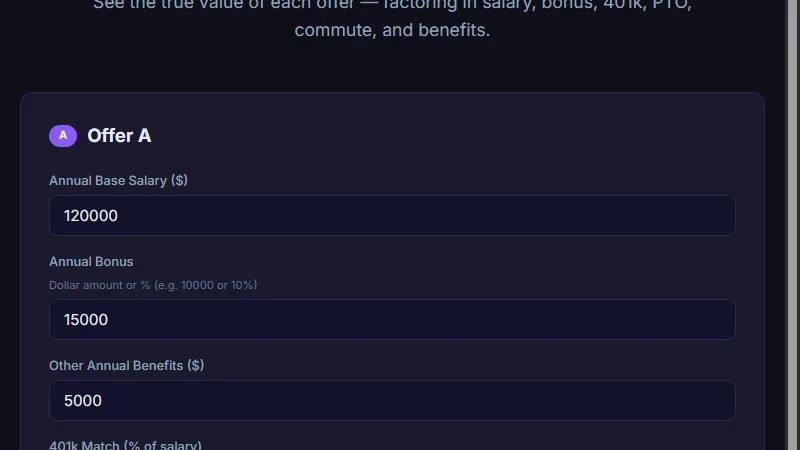
To make this process easier, use our free Job Offer Comparator tool. Enter the details of up to two offers and see the side-by-side total compensation breakdown instantly — salary, bonus, 401k match, PTO value, commute cost, insurance premiums, and more. It's the fastest way to cut through the noise and find the offer that truly pays more.