Ideal Body Weight — Comparing Devine, Robinson, Miller, and Hamwi Formulas
What It Solves
You want to know what a healthy weight is for someone of your height and gender. The answer is not a single number — there are four widely used medical formulas, each giving a slightly different result. The ideal weight calculator runs all four formulas side by side so you can see the range and understand which one applies to your situation. Devine is the most common in clinical dosing. Robinson and Miller tried to correct Devine's biases. Hamwi is the simplest rule of thumb.
The Real Problem
Most people pick a number — 150, 170, 200 — because it sounds right or because they weighed that in high school. Doctors use "ideal body weight" for more than just conversation: they use it to calculate drug dosages, ventilator settings, and nutritional support in hospitals. Using the wrong formula can lead to under-dosing or overdosing. For a 5'9" male, Devine says 154 lb, Robinson says 161 lb, Miller says 165 lb, and Hamwi says 166 lb. Which one is right? It depends on whether you are dosing medication, setting ventilation parameters, or just curious. The tool shows them all so you can decide.
How to Use It
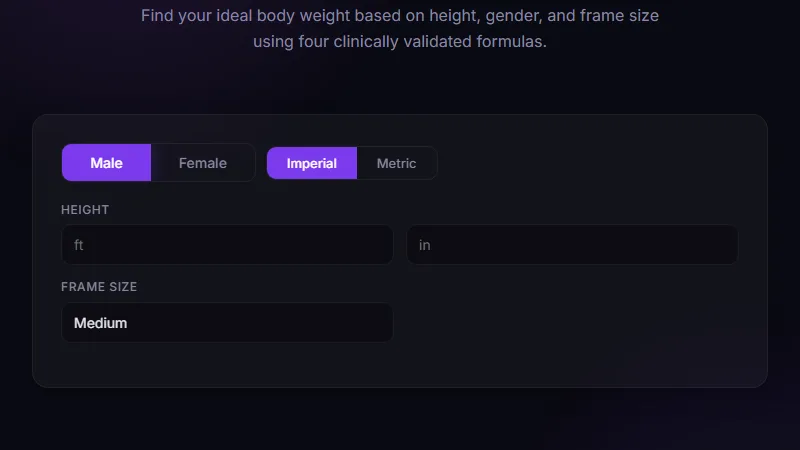
Open the ideal weight calculator and enter your height, weight, gender, and age. The tool instantly displays four IBW values. It also calculates your BMI and shows how your actual weight compares to each formula's target. The results section explains the source of each formula and its original clinical purpose. For medication dosing, clinicians typically use the Devine formula. For general fitness, Hamwi or Miller are more realistic.
Devine: 130 lb. Robinson: 133 lb. Miller: 137 lb. Hamwi: 135 lb.
Range: 130-137 lb. She is 8-15 lb above the formulas, which is within a reasonable range. Her BMI is 22.7 — comfortably in the normal category.
Adjusting Drug Dosages for a Hospital Patient
A pharmacist needs to calculate the correct dose of a weight-based medication for a 6'1" male patient who weighs 210 lb. Using his actual weight would overdose him (the drug distributes poorly in adipose tissue). Using Devine IBW: 166 lb. The pharmacist uses adjusted IBW — Devine plus 40% of the excess — arriving at 184 lb for the dosing weight. The calculator provides this adjusted figure automatically. Without IBW, the patient could receive 25% more drug than necessary.
Setting a Realistic Weight Goal for a Fitness Client
A personal trainer works with a 5'10" female client who wants to weigh 140 lb — a number she picked from a magazine. The calculator shows Devine: 150 lb, Robinson: 152 lb, Miller: 157 lb, Hamwi: 150 lb. Her current weight is 175 lb with a BMI of 25.1. The trainer explains that 140 lb is below every medical formula's recommendation and would put her at the low end of the healthy BMI range. They settle on 150 lb as the target. Twelve weeks later she hits 152 lb, looks great, and maintains easily. A goal based on data rather than aesthetics prevented an unnecessary struggle.
Limitations
All four formulas were developed decades ago using limited populations. Devine (1974) was based on a single study of 106 patients. Robinson (1983) and Miller (1985) used larger datasets but still derived from predominantly white, American populations. None of them account for body composition — a muscular athlete at 15% body fat might weigh 20 lb more than any formula predicts while being perfectly healthy. The formulas also do not apply well to elderly populations, where muscle loss and height shrinkage change the relationship between weight and health.
The calculator provides IBW for adults only (18+). Pediatric ideal weights follow completely different growth chart percentile systems. The tool also does not adjust for frame size — a person with a large bone structure might naturally sit at the top of the IBW range while a small-framed person sits at the bottom.
FAQ
Which formula do doctors actually use?
Devine is the most common in clinical settings, especially for drug dosing. The FDA uses Devine as the reference for many weight-based medications. Hamwi is popular as a quick mental calculation because of its simple 5-foot base rule.
Is IBW the same as healthy weight?
No. IBW is a calculated estimate for clinical use, not a health prescription. A person 10 lb above IBW may be perfectly healthy. BMI and body fat percentage are better health indicators than proximity to IBW.
Why do the formulas give different results?
Each was derived from different populations and designed for different purposes. Devine was originally for anesthetic dosing. Miller used a larger sample from the Metropolitan Life Insurance tables. The differences reflect their different statistical approaches.
Can I use IBW for weight loss goals?
As a reference point, yes, but do not treat it as a strict target. The range between the lowest and highest formula (often 10-15 lb) gives you a reasonable healthy weight window. Pair with the body fat calculator to confirm you are losing fat, not muscle.
What is adjusted body weight?
For patients above IBW, clinicians sometimes use adjusted body weight = IBW + 0.4 x (actual weight - IBW). This is common for drug dosing in obese patients. The tool calculates this automatically when your weight exceeds IBW by more than 30%.
Conclusion
Use this tool when you need a medical reference for ideal weight — for drug dosing, clinical assessment, or setting a evidence-informed weight target. It gives you the context of four different formulas instead of a single questionable number. Do not use it as a definitive statement of what you should weigh. Body composition, fitness, and metabolic health matter more than any formula from the 1970s. For a deeper look at what your weight is made of, combine it with the body fat calculator.
← Back to Blog