How Much House Can You Afford? — The 28/36 Rule and Real Budgets
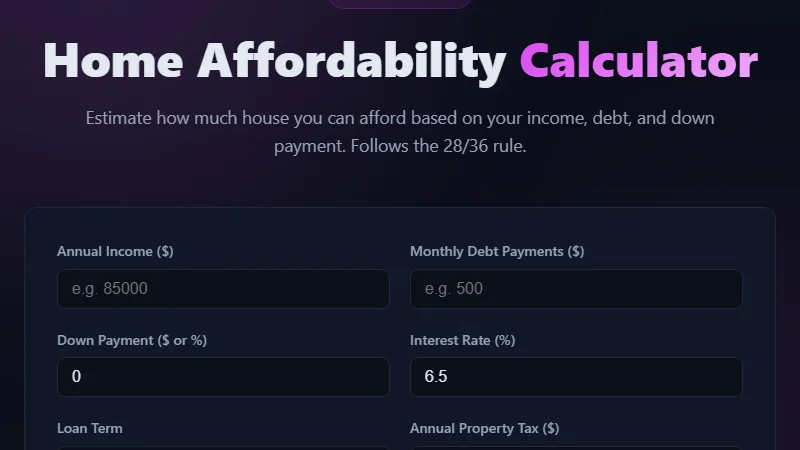
Knowing how much house you can afford is one of the most important financial decisions you will ever make. Lenders use the 28/36 rule to qualify borrowers, but your actual comfortable budget depends on your full financial picture. This post explains what lenders check, how the affordability calculation works, and how to factor in your down payment, existing debts, property taxes, and insurance.
What Lenders Actually Check
Lenders use two main ratios to determine how much you can borrow. The front-end ratio limits your monthly housing costs including principal, interest, taxes, and insurance to no more than 28% of your gross monthly income. The back-end ratio limits all monthly debt payments including housing, credit cards, student loans, and car payments to no more than 36% of your gross income. Some loan programs allow higher ratios, especially for borrowers with strong credit.
Example Affordability Calculation
Annual income: $120,000. Gross monthly income: $10,000. Front-end 28% limit: $2,800 for total housing payment. Back-end 36% limit: $3,600 for all debts. If you have $500 in monthly car and credit card payments, your maximum housing payment is still $2,800 because the front-end limit is more restrictive. At a 7% interest rate on a 30-year loan with $40,000 down and $400 monthly for taxes and insurance, the maximum home price is approximately $360,000.
Beyond the 28/36 Rule
The 28/36 rule is a lender guideline, not a personal budget recommendation. Just because a lender approves you for a certain amount does not mean you should spend that much. Your actual affordability depends on your lifestyle, savings goals, emergency fund needs, and other financial priorities. A conservative approach is to use the 25/33 rule: spend no more than 25% of gross income on housing and keep total debt under 33%. This leaves more room for saving and unexpected expenses.
Factoring the Down Payment
A larger down payment reduces your loan amount and can eliminate private mortgage insurance. For a conventional loan, 20% down removes the PMI requirement, which saves 0.5% to 1% of the loan amount annually. On a $400,000 home with 20% down, you borrow $320,000. With 5% down, you borrow $380,000 and pay PMI of roughly $150 per month. The calculator models different down payment scenarios to show the impact on monthly payment and total cost.
Property Taxes and Insurance
Property taxes vary significantly by location. A home in Texas might have 2.5% annual property tax while a home in Colorado might have 0.5%. On a $400,000 home, the difference is $8,000 per year versus $2,000 per year, which changes the monthly payment by $500. Homeowners insurance adds another $100 to $300 per month depending on the property value and location. These costs are included in the affordability calculation.
Limitations to Consider
The calculator provides estimates based on standard assumptions. Actual interest rates depend on your credit score, loan type, and market conditions. The down payment minimum varies by loan type: conventional loans typically require 5% down, FHA loans require 3.5%, and VA loans require zero down. The calculation does not include closing costs, which typically range from 2% to 5% of the purchase price. Maintenance costs and HOA fees are also not included in the basic calculation.
Frequently Asked Questions
What is the 28/36 rule in simple terms?
Your monthly housing costs should not exceed 28% of your gross monthly income, and your total monthly debt payments including housing should not exceed 36% of your gross monthly income.
Can I afford a house if I have student loans?
Yes, but student loan payments count toward your back-end ratio. The calculator accounts for existing debt payments when determining your maximum affordable home price.
How does my credit score affect affordability?
A higher credit score qualifies you for lower interest rates, which reduces your monthly payment and increases the home price you can afford. A 760+ score typically gets the best rates.
Should I include utilities in my budget?
The 28/36 rule does not include utilities, but you should factor them into your personal budget. Utilities typically add $200 to $500 per month depending on home size and location.
What is PMI and how does it affect affordability?
Private mortgage insurance protects the lender if you default. It is required when your down payment is less than 20%. PMI adds 0.5% to 1% of the loan amount per year to your monthly payment.
When to Use This Calculator vs Talk to a Lender
Use the calculator for initial planning before you start house hunting. It helps you set a realistic price range based on your income, debts, and down payment. Talk to a lender when you are ready to make an offer. The lender will pull your credit, verify your income and assets, and give you a formal pre-approval letter. Both steps are essential. The calculator sets expectations and the lender provides the official numbers.
Try the Home Affordability Calculator
Estimate how much house you can afford based on income, debts, down payment, and local tax rates.
🏡 Use the Calculator →