Estimating Flooring Material — Tiles, Hardwood, Laminate, and Vinyl
What It Solves
Buying flooring means matching the room area to the material coverage, and every flooring type comes in different box sizes, roll widths, or tile counts. Hardwood comes in cartons covering 15 to 25 square feet. Laminate ranges from 10 to 20 square feet per box. Vinyl rolls come in 6, 12, or 13-foot widths. Tile is sold by the case, with each case covering anywhere from 8 to 15 square feet depending on tile size. The mismatch between room dimensions and material packaging is where overordering and underordering happen.
The Real-World Problem
A typical mistake: A 12x14 bedroom is 168 square feet. The homeowner picks a laminate that covers 19.5 square feet per carton. They divide 168 by 19.5, get 8.6, and round up to 9 cartons. But they forgot the 10 percent waste factor for straight installation. That adds 17 square feet, making the total 185 square feet, which is 9.5 cartons. They buy 9 and run half a carton short. The store is out of that lot number, and the replacement carton has a slightly different shade. Now there is a visible seam line where the two lots meet. The entire floor has to be redone or the furniture arranged to hide the line.
Diagonal installation requires up to 15 percent waste. Patterned tile layouts like herringbone can waste 20 percent or more. Irregular rooms with alcoves, bay windows, and closets need individual section measurements. The typical approach of multiplying length by width and adding a flat percentage breaks down when the room shape is complex.
How to Use It
Start by measuring each room section separately. For a rectangular room, enter length and width. For L-shaped areas, break them into two rectangles and enter each as a separate section. The tool sums the areas and applies the waste percentage you select based on your installation pattern. You then enter the coverage per box or per roll for your specific material. The tool converts the total area into the number of boxes, cartons, or rolls you need.
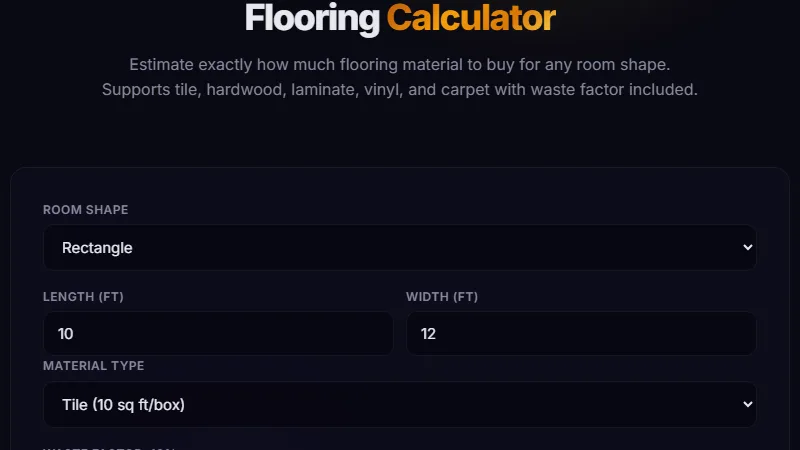
Total area: 300 + 180 = 480 sq ft.
Add 10% waste: 528 sq ft.
Hardwood at 22 sq ft per carton: 528 / 22 = 24 cartons.
Vinyl plank at 18 sq ft per box: 528 / 18 = 29.3, buy 30 boxes.
Matching Tile Layouts to Room Dimensions
Sofia is tiling her kitchen, which is 11x13 feet with a 3x4-foot island footprint. The tile is 12x24 inches, sold in cases of 8 tiles, each case covering 16 square feet. She enters the room dimensions and subtracts the island as a non-tiled area. The tool handles the deduction. Total area is 143 minus 12 equals 131 square feet. With 15 percent waste for the running bond pattern she chose, the total is 151 square feet. That is 9.4 cases, so she buys 10. Without the tool, she would have measured floor area at 143 square feet, bought 9 cases, and been short by a full case when the pattern waste kicked in.
Planning a Multi-Room Installation with Transitions
David is installing engineered hardwood in three bedrooms and a hallway. Each room is a different size. He enters each room separately into the tool. The hallway is 3x25 feet with two 90-degree turns. He splits it into three straight segments. The tool gives him a total for all areas combined, which he uses to order materials in bulk. The breakdown per room helps him plan where to start each run to minimize waste. He ends up ordering 15 percent less material than his contractor estimated, saving $340 on a $2,200 project.
Limitations
The waste factor is an estimate. Actual waste depends on the installer's skill, the complexity of the room, and the plank or tile length. Long continuous runs with minimal cutting waste less than rooms with many corners. The tool also does not account for underlayment, vapor barriers, or transition strips — those are separate purchases. It assumes the same material throughout — if you are using different flooring in different rooms, calculate each material separately.
For irregular shapes like curved walls or circular rooms, break the area into geometric sections manually and enter them as separate rectangles or triangles. The tool handles rectangles and L-sections directly but does not have a free-draw mode.
FAQ
How much waste should I include for standard installation?
Straight lay installation: 5 to 10 percent. Diagonal: 15 percent. Herringbone or chevron patterns: 20 percent. Tile installed with 1/8-inch grout lines adds about 1 percent compared to tight-laid tile.
What if my room is not perfectly rectangular?
Break it into rectangles, triangles, and other simple shapes. Measure each section individually and enter them as separate areas. The tool will sum them. For bay windows, measure the alcove as a separate rectangle and add it.
Does the tool account for different plank widths?
Plank width affects the number of planks needed but not the total square footage. The tool calculates square footage only. Width becomes relevant for estimating how many rows you will need for the visual layout, not for material quantity.
Should I order extra for future repairs?
Most manufacturers recommend keeping one extra box for future repairs. Add that to your order. For tile, keep a full case. For hardwood or laminate, keep one carton. Store it in the same environment as the installed floor.
Can I use this for carpet?
Yes, but carpet is sold by the square foot and comes in standard roll widths of 12 or 15 feet. You will need to calculate how many linear feet of a given roll width you need. The tool gives square footage — divide by the roll width to get linear feet, then round up to the next foot.
Conclusion
This method works for any room where you know the dimensions and have chosen a material. It replaces the guesswork and saves the cost of extra material or the frustration of a shortage. Do not rely on it for commercial installations where pattern matching across large areas requires professional estimation — the waste factors are calibrated for residential-scale projects. For carpet or specialty materials, confirm coverage rates with the supplier before ordering.
If you are painting the room before laying the floor, the paint calculator covers wall coverage. And for measuring oddly shaped rooms before ordering any material, the square footage calculator is a good first step.
← Back to Blog