EV Charging Time and Cost Guide — How Long and How Much to Charge Your Electric Vehicle
1. Introduction
If you're new to electric vehicles, two questions probably come up before any road trip or daily commute: how long will this take? and how much will it cost? Unlike refueling a gas car, where the answer is always "five minutes" and "whatever the pump says," EV charging depends on a handful of variables — your charger type, your battery size, your current charge level, and your local electricity rate.
This guide walks through each variable so you can estimate charging time and cost for any EV, at any charger. Whether you're plugging into a standard household outlet or a 350 kW DC fast charger, you'll know exactly what to expect.
2. Charger Types Explained
Every EV charger falls into one of three categories. The charging speed — measured in kilowatts (kW) — determines how many miles of range you recover per hour.
- Level 1 (120V, 1.2–1.8 kW) — Uses a standard household outlet. Adds about 3–5 miles of range per hour. Best for plug-in hybrids or overnight top-ups at home when you drive fewer than 40 miles a day.
- Level 2 (240V, 3.3–19.2 kW) — The most common home and workplace setup. Adds 12–60 miles of range per hour depending on the charger and vehicle. A typical home unit runs at 7.2–11.5 kW, which can fully recharge most EVs overnight.
- DC Fast Charging (50–350 kW) — Found at highway rest stops and charging stations. Adds 100–300 miles of range in 20–40 minutes. Not all EVs can accept the full speed — the vehicle's onboard charge rate is often the limiting factor.
3. How Battery Capacity Affects Charge Time
Battery capacity is measured in kilowatt-hours (kWh) — the total energy the pack can store. Think of it as the size of your "fuel tank." A larger battery stores more energy and takes longer to fill, even when the charger supplies the same power.
For example, charging a 40 kWh Nissan Leaf from empty to full on a 7.2 kW Level 2 charger takes roughly 5.5 hours. The same charger needs nearly 13 hours to fill a 91 kWh Ford Mustang Mach-E. The battery size directly scales the time required.
Your vehicle's onboard charger also matters. If your car can only accept 7.2 kW AC input, plugging into an 11.5 kW Level 2 station won't charge any faster — the car is the bottleneck.
4. The Charging Math
You can estimate any charge session with one formula:
Let's walk through a real scenario. You own a Tesla Model 3 with a 75 kWh battery. You arrive at a Level 2 charger at 20% and want to reach 80%. The charger delivers 11.5 kW.
- Energy needed: 75 × (0.80 − 0.20) = 45 kWh
- Time: 45 ÷ 11.5 = 3.9 hours
The same car on a 150 kW DC fast charger (assuming it can sustain that rate): 45 ÷ 150 = 0.3 hours, or about 18 minutes. Keep in mind DC fast charging slows down after 80% to protect the battery, so the last 20% can take as long as the first 80%.
5. What Charging Actually Costs
EV charging cost depends entirely on where and when you charge. Here's how the three tiers compare:
- Home charging — US average is about $0.14/kWh. At that rate, a full charge for a 75 kWh Tesla Model 3 costs roughly $10.50. Rates vary widely: Washington state averages $0.10/kWh, while California and Hawaii can exceed $0.30/kWh. Charging overnight on a time-of-use plan can cut your cost by 30–50%.
- Workplace / free charging — Many employers offer Level 2 charging at no cost. If you can charge for free during the workday, your fuel cost drops to essentially zero.
- DC fast charging — Public fast chargers typically charge $0.30–$0.60/kWh. At $0.48/kWh, the same 75 kWh battery costs about $36 to fill from empty. Some networks also tack on per-minute idle fees.
On a per-100-miles basis: home charging runs $3.50–$5.00, workplace charging is often free, and DC fast charging lands at $10–$18. Compare that to a gas car getting 30 mpg at $3.50/gallon — that's about $11.67 per 100 miles. Home charging is almost always the cheapest option.
6. Real-World Examples
The table below shows estimated charging times and costs for three popular EVs across all charger levels. Times assume charging from 20% to 80% state of charge.
| Vehicle | Battery | Level 1 (1.4 kW) | Level 2 (7.2 kW) | DC Fast (150 kW) | Home Cost* |
|---|---|---|---|---|---|
| Tesla Model 3 | 75 kWh | 32 h | 6.3 h | 18 min | $6.30 |
| Nissan Leaf | 40 kWh | 17 h | 3.3 h | 10 min | $3.36 |
| Ford Mach-E | 91 kWh | 39 h | 7.6 h | 22 min | $7.64 |
* Home cost calculated at $0.14/kWh for energy needed from 20% to 80%.
7. Tips to Save on EV Charging
Reducing your charging bill is straightforward with a few habits:
- Charge overnight — Most utilities offer time-of-use rates with cheaper electricity from 9 PM to 6 AM. Scheduling your car to charge during those hours can cut fuel costs by 30–50%.
- Use free and workplace charging — Plug in at the office, grocery stores, or shopping centers that offer complimentary Level 2 charging. Apps like PlugShare and ChargePoint show nearby free stations.
- Stay between 20% and 80% — Lithium-ion batteries charge fastest and degrade slowest in this sweet spot. Unless you need the full range for a long trip, stopping at 80% saves both time and battery health.
- Pre-condition your battery — Many EVs let you warm the battery while still plugged in before a fast-charging stop. This lets the car sustain a higher charge rate for longer, shaving minutes off each session.
- Use subscription plans — Networks like Electrify America and EVgo offer membership tiers that reduce per-kWh rates if you fast charge frequently. A $4–$8 monthly fee can save you $0.05–$0.12/kWh.
8. Conclusion
Charging an EV isn't complicated once you understand the three levers: charger power, battery size, and electricity rate. Level 1 handles overnight top-ups, Level 2 is the workhorse for daily driving, and DC fast charging makes road trips practical. The math is simple — kWh needed ÷ power = hours — and running the numbers before you plug in removes all the guesswork.
Home charging is almost always the cheapest and most convenient option, especially if you take advantage of off-peak rates. As the public fast-charging network expands, even long-distance travel is becoming faster and more predictable.
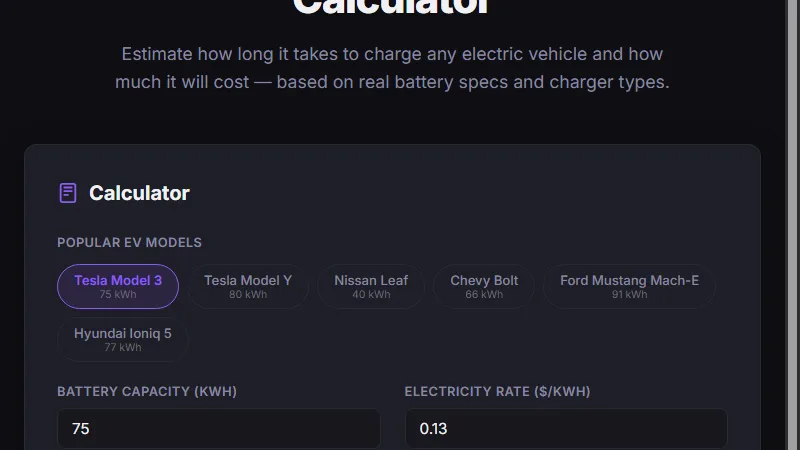
Want to run your own numbers? Try the EV Charging Calculator to estimate charging time and cost for any electric vehicle at Level 1, Level 2, or DC fast charging.