Conduit Fill Calculator Guide — NEC Sizing Made Easy
Proper conduit fill is one of the most common challenges electricians face in the field. Overfill a conduit and you risk overheating conductors, damaging insulation during pulling, and failing electrical inspection. Underfill and you waste material and raceway space. The National Electrical Code provides clear guidelines in Chapter 9 for maximum conductor fill, and a good conduit fill calculator makes applying those rules fast and accurate.
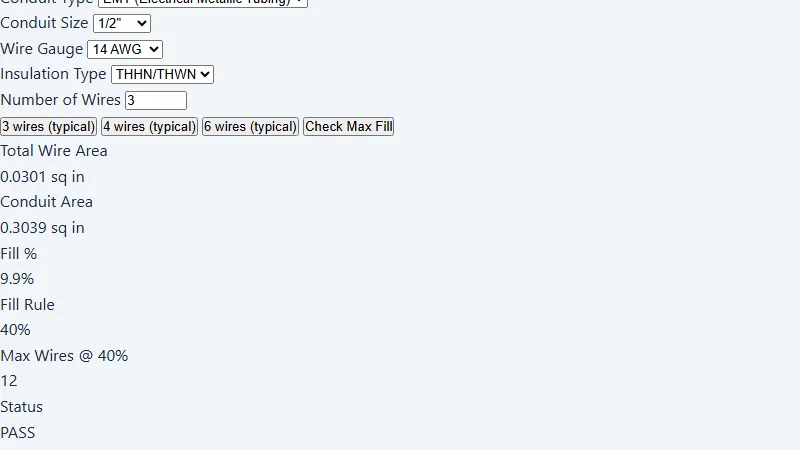
Understanding NEC Chapter 9 Conduit Fill Requirements
The NEC specifies maximum fill percentages based on the number of conductors installed in a single conduit. For one conductor, the maximum fill is 53 percent of the conduit cross-sectional area. For two conductors, it drops to 31 percent. For three or more conductors, the limit is 40 percent. These percentages ensure that enough air space remains around conductors to dissipate heat and that pulling tensions stay within safe limits.
Each conductor type has a different cross-sectional area. For example, a 12 AWG THHN wire has an area of 0.0133 square inches, while a 10 AWG THHN wire takes 0.0211 square inches. These values come from NEC Chapter 9 Table 5 and are based on the actual physical dimensions of the insulation and conductor together.
Example 1: Three 12 AWG THHN Wires in EMT
Suppose you need to run three 12 AWG THHN current-carrying conductors through EMT conduit. Using NEC Table 5, each 12 AWG THHN has a cross-sectional area of 0.0133 sq in. The total conductor area is 3 x 0.0133 = 0.0399 sq in.
At the 40 percent fill limit for three conductors, you need a conduit whose internal area is at least 0.0399 / 0.40 = 0.09975 sq in. Per NEC Chapter 9 Table 4, a 1/2-inch EMT has an internal area of 0.122 sq in for 40 percent fill, so 1/2-inch EMT is sufficient. This is the most common conduit size for a three-wire 15 or 20 ampere lighting circuit.
Example 2: Mixed Wire Sizes in a Single Conduit
Real-world installations frequently mix wire sizes in the same conduit. Imagine a feeder that includes two 2 AWG THHN conductors, one 4 AWG THHN neutral, and an 8 AWG THHN equipment ground through IMC conduit. You must sum the individual areas and check against the conduit capacity.
Two 2 AWG THHN at 0.1158 sq in each totals 0.2316 sq in. The 4 AWG THHN adds 0.0824 sq in, and the 8 AWG THHN ground adds 0.0366 sq in. The total area of all four conductors is 0.3506 sq in. A 1-inch IMC has a 40 percent fill area of 0.355 sq in per Table 4. This barely fits. The result shows how mixed sizes force you to calculate precisely rather than relying on rule-of-thumb conduit sizing.
The 40 Percent Fill Rule Explained
The 40 percent fill rule applies when a conduit contains three or more conductors. This limit accounts for the space taken by all conductors plus the air gap needed for airflow. Heat builds up inside conduits when current flows, especially in long runs with multiple bends. The 40 percent threshold provides a balance between efficient use of space and safe thermal performance.
When conductors carry high currents or are installed in ambient temperatures above 30 degrees Celsius, you may need to derate the conductor ampacity per NEC Table 310.15(B)(16) and adjust based on the number of current-carrying conductors. More than three current-carrying conductors in a conduit require derating even if fill is within 40 percent.
Derating Considerations for Conduit Fill
NEC Section 310.15(B)(3)(a) requires ampacity adjustment when more than three current-carrying conductors are bundled in a raceway or cable. The adjustment factors are 80 percent for 4 to 6 conductors, 70 percent for 7 to 9, 50 percent for 10 to 20, and so on. This means you could size a conduit for acceptable fill but still need larger conductors to compensate for the heat from closely packed wires.
A conduit fill calculator that accounts for derating factors is essential for high-density installations such as panelboard feeders or control cabinets. Enter the number of conductors, the wire size and type, and the conduit material to get a complete answer that includes both fill percentage and ampacity derating.
Conduit Types and Their Fill Differences
EMT, PVC Schedule 40, PVC Schedule 80, and IMC each have different internal diameters. For a one-inch trade size, EMT has an internal diameter of 1.049 inches, while PVC Schedule 80 has only 0.957 inches due to thicker walls. This difference directly affects the available fill area. A PVC Schedule 80 conduit of the same trade size holds fewer or smaller conductors than the equivalent EMT. Always verify the specific conduit type's dimensions from NEC Chapter 9 Table 4 rather than assuming the trade size alone determines capacity.
Frequently Asked Questions
What is the 40 percent conduit fill rule?
The NEC requires that when a conduit contains three or more conductors, the sum of the conductor cross-sectional areas must not exceed 40 percent of the conduit's internal cross-sectional area. This prevents overheating and makes wire pulling practical.
Can you pull different gauge wires through the same conduit?
Yes. Conductors of different sizes can share a conduit as long as the total fill stays within the permitted percentage. Add the individual areas of all conductors and check against the conduit capacity for the chosen conduit type.
Does the conduit material change the fill calculation?
Yes. EMT, PVC, and IMC have different wall thicknesses and therefore different internal diameters at the same trade size. Always use the specific conduit type's data from NEC Chapter 9 Table 4 for accurate fill calculations.
What happens if conduit fill exceeds 40 percent?
Exceeding the fill limit violates NEC code and risks overheating conductors, damaging insulation during installation, and failing inspection. You must move up to the next available conduit size or reduce the number or size of conductors.
Do I count the ground wire in conduit fill?
Yes. Equipment grounding conductors count toward conduit fill even though they do not normally carry current. The NEC requires all conductors occupying the same raceway to be included in the fill calculation.
Choosing the Right Conduit Size for Your Installation
When planning a conduit run, start by listing every conductor that will occupy the raceway, including neutrals, grounds, and spare conductors. Look up the cross-sectional area for each conductor size and type from NEC Table 5. Sum the areas and divide by the allowed fill percentage to find the minimum internal area required. Then select a conduit type and size whose internal area meets or exceeds that value. A conduit fill calculator automates this entire process and reduces the chance of arithmetic errors that can lead to expensive rework.
Try the Conduit Fill Calculator
Size EMT, PVC, and IMC conduit per NEC Chapter 9 instantly. Supports all standard wire types and mixed sizes.
⚡ Use the Calculator →