How Much Concrete Do You Need? — Slabs, Columns, Footings, and Steps
What It Solves
You are pouring concrete and you need to know exactly how much to order. Too little means a cold joint and a structural weak point. Too much means paying for material you cannot return, plus disposal fees. The problem is that concrete is sold by the cubic yard, but your project is measured in feet and inches. Converting between those units while accounting for the shape of the pour is where most mistakes happen.
The Real-World Problem
A homeowner decides to pour a 20-by-30-foot patio, 4 inches thick. They calculate 20 times 30 equals 600 square feet. Divide by 80 (the old rule of thumb) and get 7.5 yards. They order 8 yards. The actual calculation is 20 x 30 x 0.333 (4 inches in feet) divided by 27 (cubic feet per cubic yard). That is 7.4 cubic yards. With waste and compaction, 8 yards is close but cutting it fine. If the subgrade is uneven and the pour averages 4.5 inches, they need 8.3 yards. Suddenly that 8-yard order leaves them short by a third of a yard. A short pour on a weekend means a panic call to the ready-mix plant and an extra delivery fee that often exceeds the cost of the concrete itself.
The issue is compounded when the project has multiple shapes. A driveway with an apron, a walkway, and a parking pad — each section needs its own volume calculation. Add a footer for a retaining wall and the math multiplies. Most people default to over-ordering by a full yard to be safe, which at current prices adds $150 to $200 to the job.
How to Use It
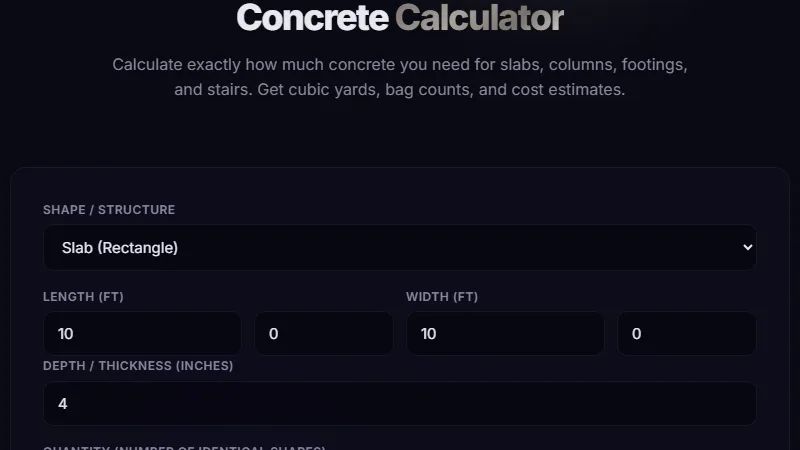
Open the tool and start with the shape that matches your project. For a slab, enter the length, width, and thickness in inches or feet. The tool converts everything to cubic yards automatically. For a column or round post footer, use the cylinder option — enter diameter and height. For footings, use the linear footer mode where you specify width, depth, and total length. Each shape adds to a running total so you can build up a complete project estimate.
Volume: 24 x 36 x 0.4167 = 360 cubic feet. 360 / 27 = 13.33 cubic yards.
Add 10% waste: 14.7 cubic yards. Order 15 yards.
In bags: 15 yards = 405 cubic feet. At 0.45 cubic feet per 60-lb bag, that is 900 bags. Have it delivered.
Pouring a Patio with Integrated Steps
Maria is replacing her front stoop and walkway. The landing is 4x5 feet, the three steps are 3 feet wide with 7-inch risers and 11-inch treads, and the walkway is 3 feet wide by 15 feet long. Each step riser and tread combination is a separate volume. She enters the landing as a slab, adds the steps using the stair calculator mode, and the walkway as another slab. The tool totals 1.2 cubic yards. She orders 1.5 to account for the irregular subgrade and gets the job done without a second trip. Before the tool, she would have estimated 2 yards based on "it looks like about that much" and spent $80 on concrete she did not need.
Building a Retaining Wall Foundation
Carlos is building a 40-foot-long retaining wall. The footer needs to be 16 inches wide and 8 inches deep per the engineering plan. The linear footer calculation is straightforward: 40 feet times 1.33 feet times 0.667 feet equals 35.5 cubic feet, or 1.3 cubic yards. But the wall also has a drain rock base and a sump at the low end. He adds a 2x2x2 sump pit as a cube. The tool handles the mixed-unit input without requiring him to convert everything to feet first. The total comes to 1.7 yards. He orders 2 yards and uses the excess for a small garden pad nearby.
Limitations
The tool calculates theoretical volume based on the dimensions you enter. It does not account for subgrade irregularities, compaction settling, or the fact that concrete is often ordered slightly wetter than spec, which increases yield slightly. It also assumes standard rectangular or cylindrical shapes — for free-form curves or irregular site-cast shapes, you need to break the area into smaller geometric sections and sum them manually.
The bag count estimate assumes 60-lb or 80-lb bags with standard yield. Actual bag yield varies by brand and mix design. For critical structural applications, always consult a structural engineer and order from a ready-mix supplier rather than relying on bagged concrete.
FAQ
Should I order by the yard or by the bag?
For anything over 2 cubic yards, ready-mix delivery is cheaper and more consistent. Bagged concrete works for small projects like fence posts or small repairs. One cubic yard equals about 60 bags of 80-lb mix.
How much waste should I add?
5 to 10 percent is standard for slabs on compacted subgrade. Add 15 percent for footings or forms where spillage is more likely. For steep slopes or pour-bucket access, add 20 percent.
Does the tool account for rebar or gravel?
No. Rebar displaces negligible volume. Gravel base is separate — calculate it the same way but use gravel depth instead of concrete thickness. The tool is for concrete volume only.
What about concrete weight for transport?
Concrete weighs about 4,000 lbs per cubic yard. A full truck carries 10 to 12 yards. If you are using bagged mix, 60-lb bags yield about 0.45 cubic feet each. The tool shows approximate weight based on these averages.
Can I use this for mortar or grout?
The volume math is the same, but mortar and grout have different yield characteristics. Check the manufacturer's coverage for the specific product. The tool is calibrated for standard concrete mix designs.
Conclusion
Use this approach when you are ordering concrete for any slab, footer, column, or set of steps. It replaces the guessing game with reliable geometry that matches how ready-mix plants quote. Do not rely on it for structural load calculations — volume is only one part of the engineering equation. For deck footings, fence posts, or small pads where you are mixing bags by hand, the tool prevents the most common concrete mistake: ordering not enough on a Friday afternoon.
If you are also working on the surrounding yard, the sod calculator can help plan lawn restoration after the concrete work, and the square footage calculator is useful for measuring irregular areas before you form them up.
← Back to Blog