Car Payments — How to Calculate What You'll Actually Pay with Tax and Fees
The sticker price is only the starting point when buying a car. Sales tax, documentation fees, registration, and other charges can add thousands to the amount you finance. This post walks through the full cost breakdown, explains the 20/4/10 rule for car affordability, and shows how trade-in value and down payment affect your monthly payment.
Why the Sticker Price Is Misleading
When a dealer quotes a price of $35,000, the actual amount you finance will be higher. Sales tax typically adds 4% to 10% depending on your state. Documentation fees range from $100 to $800. Registration and title fees add another $50 to $300. A $35,000 car in a state with 8% sales tax and $500 in fees results in a financed amount of $38,300 before any down payment or trade-in. That hidden $3,300 increases both the loan amount and the monthly payment.
How to Use the Payment Calculator
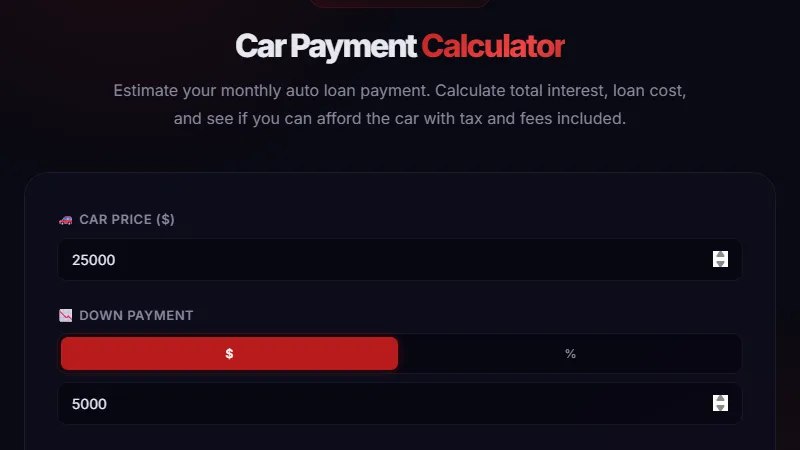
Enter the car price, down payment amount, trade-in value, sales tax rate, documentation and registration fees, interest rate, and loan term. The calculator shows the total financed amount, monthly payment, total interest paid, and a full amortization schedule. You can adjust any input to see how it changes the payment.
Example Input and Output
Car price: $35,000. Down payment: $5,000. Trade-in: $3,000. Sales tax: 8%. Doc fees: $500. Rate: 6.5%. Term: 60 months.
Taxable amount: $35,000 minus $3,000 trade-in equals $32,000. Sales tax: $2,560. Total financed: $35,000 minus $5,000 minus $3,000 plus $2,560 plus $500 equals $30,060. Monthly payment: $588. Total interest over 5 years: $5,220. Total cost of the car: $35,000 plus $2,560 tax plus $500 fees plus $5,220 interest equals $43,280.
The 20/4/10 Affordability Rule
The 20/4/10 rule is a simple guideline for car affordability: put down at least 20% of the purchase price, finance for no more than 4 years, and keep your total monthly car expenses including payment, insurance, and fuel under 10% of your gross monthly income. For a household earning $60,000 per year ($5,000 per month), the 10% rule means total car expenses should be under $500 per month. A $588 monthly payment on a $35,000 car would exceed this limit.
Trade-In Value and Negative Equity
If you owe more on your current car than it is worth, you have negative equity. That negative amount gets rolled into the new loan, increasing the financed amount. For example, if you owe $12,000 on your trade-in and it is worth $10,000, the $2,000 difference is added to the new loan. This can quickly make a reasonable purchase unaffordable. The calculator subtracts trade-in value from the price before applying tax.
Sales Tax Variations by State
Some states calculate sales tax on the full purchase price, others allow you to deduct the trade-in value before applying tax, and a few have no sales tax at all. The calculator lets you choose whether trade-in is deducted before tax. In the example above, deducting the $3,000 trade-in saves $240 in sales tax compared to taxing the full price.
Limitations to Consider
The calculator provides estimates based on the inputs you provide. Actual interest rates depend on your credit score, loan term, and the lender. Insurance costs are not included in the monthly payment calculation but should be part of your total budget. Extended warranties, gap insurance, and dealer add-ons are not included. The calculation assumes a simple interest loan with no prepayment penalty.
Frequently Asked Questions
What is the difference between a down payment and a trade-in?
A down payment is cash you pay upfront. A trade-in is the value of your current car applied to the purchase. Both reduce the amount you need to finance. Trade-in value may also reduce the sales tax in some states.
How does my credit score affect my car payment?
Your credit score determines the interest rate you qualify for. A score of 760 or higher might get you 5% while a score of 620 might get 10% or higher. On a $30,000 loan, a 5% rate costs $566 per month while a 10% rate costs $637 per month over 60 months.
What are documentation fees?
Documentation fees cover the dealer's cost of processing paperwork. They range from $100 to $800 and are regulated by some states. The fee is added to the financed amount.
Should I put more money down or invest it?
If your car loan rate is higher than your expected investment returns, put more down. Auto loan rates are typically 6% to 10%, which is higher than conservative investment returns. A larger down payment also ensures you are not upside-down on the loan.
What is the best loan term for a car?
Shorter terms (36 to 48 months) have lower interest rates and build equity faster. Longer terms (60 to 84 months) lower the monthly payment but cost more in interest and increase the risk of negative equity.
When to Buy and When to Keep Driving Your Current Car
A car payment calculator is useful when you are considering a new or used car purchase, comparing financing options from different lenders, or deciding between buying and leasing. If your current car is reliable and paid off, keeping it is almost always cheaper than buying a new one. The calculator helps you see the real monthly and total cost before you walk into the dealership, so you negotiate from a position of knowledge rather than emotion.
Try the Car Payment Calculator
Calculate your actual monthly payment with tax, fees, trade-in, and down payment all included.
🚗 Use the Calculator →