How Many Calories Do You Actually Need? — TDEE and the Mifflin-St Jeor Equation
What It Solves
You need to know how many calories your body burns per day so you can set an intelligent target for weight loss, maintenance, or gain. The number depends on your height, weight, age, gender, and how much you move. Guessing leads to either starvation diets that crash your metabolism or surplus eating that produces more fat than muscle. The calorie calculator uses the Mifflin-St Jeor equation — the most clinically validated BMR formula — and applies a five-tier activity multiplier to reach total daily energy expenditure.
The Real Problem
Activity trackers and generic charts are consistently wrong. A Fitbit might say you burned 2,500 calories today while the actual number is closer to 2,100. On the flip side, "eat 1,200 calories" advice ignores that a 6'2" man and a 5'2" woman have dramatically different maintenance levels. The result is that people either eat too little (losing muscle, feeling exhausted) or too much (wondering why the scale will not move). The Mifflin-St Jeor equation was developed in 1990 and remains the most accurate predictive equation for the general population. It is the standard used by dietitians and clinicians.
How to Use It
Open the calorie calculator and enter your age, gender, height, and weight. Select your activity level honestly — "sedentary" means a desk job with almost no exercise, not "I walked to the bus stop." Pick your goal: lose, maintain, or gain. The tool calculates BMR using the Mifflin-St Jeor formula, multiplies by the activity factor, and then adjusts by 10-20% depending on your goal. The result shows maintenance calories, deficit calories, and surplus calories so you can decide which approach fits your plan.
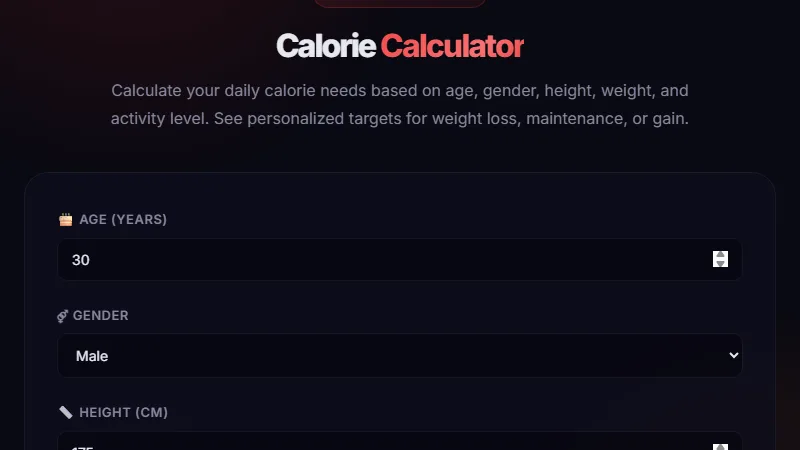
BMR: 1,410 kcal. TDEE: 1,940 kcal. Deficit (-20%): 1,550 kcal.
At 1,550 calories per day she should lose about 0.8 lb per week. At this level she can still eat three satisfying meals without dropping below safe minimums.
Coaching a Client Past a Weight-Loss Plateau
Marcus is a 45-year-old who lost 12 pounds in 8 weeks on 1,800 calories but has stalled for 3 weeks. He reruns the calculator with his new weight. His TDEE has dropped from 2,450 to 2,310 because he is lighter. The tool now recommends 1,850 for continued loss — only 50 calories lower than before. Marcus realizes the plateau is not a metabolic problem but a compliance drift. He starts weighing portions again and the scale moves within 10 days. The lesson: recalculate every 10-15 pounds lost because your TDEE shrinks with you.
Setting Maintenance Calories After a Diet
After losing 25 pounds, Elena is terrified of regaining. She has been eating 1,400 calories during her cut. The calculator shows her new maintenance at 1,970. She reverse-diets by adding 100 calories per week over 6 weeks until she hits maintenance. Because she knows the exact target, she avoids the common rebound of 5-10 pounds of water weight and fat regain. The tool gives her a structured off-ramp instead of the usual "just eat normally" advice that derails most dieters.
Limitations
The Mifflin-St Jeor equation estimates BMR for the general population but can overestimate or underestimate by 100-200 calories for individuals with very high muscle mass or specific metabolic conditions. The activity multiplier is the weakest link — "moderately active" is subjective and most people overestimate how active they are. If you select "very active" but sit at a desk 8 hours a day, your actual TDEE will be lower than the calculator suggests.
The tool also does not account for non-exercise activity thermogenesis (NEAT) — the calories burned from fidgeting, standing, and daily movements. Two people with the same stats and workout schedule can differ by 300+ calories based on NEAT alone. Use the output as a starting estimate and adjust based on 2-4 weeks of real data.
FAQ
Is Mifflin-St Jeor better than Harris-Benedict?
Yes. Multiple validation studies show Mifflin-St Jeor has lower error rates (within 10% of measured BMR about 80% of the time). Harris-Benedict was developed in 1919 and tends to overestimate by 5-10% in modern populations.
How often should I recalculate?
Every 10-15 pounds of weight change or when your activity level shifts significantly. Your BMR changes as your body composition changes, and using old numbers will slowly drift you off target.
What is the minimum safe calorie intake?
Generally 1,200 for women and 1,500 for men, but these are rough floors. Below those levels it becomes very difficult to meet micronutrient needs. The calculator will warn you if your deficit target drops below safe thresholds.
Should I eat more on workout days?
The activity multiplier already averages your weekly energy expenditure. If you want to shift calories from rest days to workout days, keep the weekly total the same. The tool gives you a daily average, not a strict daily mandate.
Conclusion
Use this tool when you need a science-backed starting point for daily calorie intake based on your body and lifestyle. It replaces guesswork with a validated formula used by registered dietitians. Do not use it as an unchangeable prescription — treat it as a hypothesis and adjust based on your actual weight trend over several weeks. For a deeper breakdown of where those calories should come from, pair it with the macro calculator to get specific protein, carb, and fat targets.
← Back to Blog