Estimating Body Fat with Circumference Measurements — The Navy Method
What It Solves
You need a way to estimate your body fat percentage without access to a DEXA scan, hydrostatic weighing, or expensive bioelectrical impedance devices. The body fat calculator uses the U.S. Navy circumference method — measurements you can take at home with a simple tape measure. It gives you a body fat estimate based on your height and the circumference of your neck and waist (and hips for women). No electrodes, no water tanks, no subscription fees.
The Real Problem
The scale lies. It tells you how much you weigh but not what that weight is made of. Two people who weigh 180 pounds can look completely different — one at 12% body fat, the other at 25%. The heavier person might actually be healthier. Without a body fat estimate, you cannot tell whether the 5 pounds you lost was fat, muscle, or water. Most consumer body fat scales are notoriously inaccurate, varying by 4-8% depending on hydration and time of day. The Navy method, while not perfect, gives consistent results that correlate well with DEXA when measured correctly.
How to Use It
Open the body fat calculator. You will need a flexible tape measure. For men: measure your neck circumference just below the larynx and your waist at the navel level. For women: measure your neck, your natural waist (narrowest point), and your hips (widest point). Enter your height and the measurements. The tool applies the Navy-derived regression formula to estimate body fat percentage, fat mass, and lean mass. Take measurements first thing in the morning for consistency — post-meal bloating and hydration affect waist circumference.
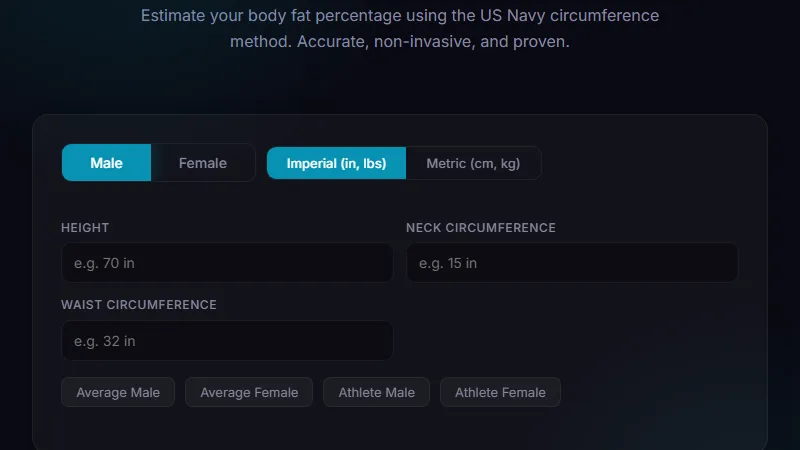
Body fat %: 21.4%. Fat mass: 41.7 lb. Lean mass: 153.3 lb.
This puts him in the "acceptable" category. If he drops to a 33" waist while maintaining muscle, he would hit about 16% — the "fitness" range.
Tracking Progress Through a Body Recomposition Phase
David is 5'9", 170 pounds, and has been lifting for 2 years. His weight has not changed in 6 weeks, but his clothes fit differently. He measures with the tool: 15.8% body fat. Eight weeks of maintenance-calorie training later, he remeasures: 14.2% body fat. His weight stayed at 170, but he gained 2.7 pounds of lean mass and lost 2.7 pounds of fat. The tool captured the recomp that the scale completely missed. Without it, David might have thought he was stagnating and switched to a cut that would have undermined his progress.
Screening for Health Risk in a Primary Care Context
A personal trainer working with 50+ clients uses the tool as a quick screening during intake. One client, a 58-year-old man with a BMI of 24.9 (normal range), measured 28% body fat with a 40" waist. The Navy method flagged him as "obese" by body fat standards despite his normal BMI. The trainer adjusted his program to prioritize fat loss over general fitness. Three months later the client dropped to 23% body fat and his blood work improved across the board. BMI alone would have missed the risk entirely.
Limitations
The Navy method assumes a typical distribution of fat and does not account for individual variations. People who carry more fat in their legs or lower body (common in endurance athletes) may get lower readings than reality. The formula also loses accuracy at very low body fat percentages (below 8% for men, below 15% for women) because circumference changes become too small to measure reliably. Measuring technique matters — pulling the tape too tight or measuring at the wrong height changes results by 2-3%. Always measure at the same spots, at the same time of day, and use the same tape.
The tool also does not distinguish between subcutaneous fat (under the skin) and visceral fat (around organs). Visceral fat is the more dangerous type and is not captured by circumference alone. A waist measurement over 40 inches (men) or 35 inches (women) suggests high visceral fat regardless of body fat percentage.
FAQ
How accurate is the Navy method compared to DEXA?
Studies show the Navy method correlates with DEXA within 2-4% for most people when measured correctly. It is significantly more accurate than consumer bioelectrical impedance scales and roughly comparable to caliper measurements with less technique dependency.
Do I measure with or without clothing?
Without clothing or with very thin clothing that does not add bulk. Shirts, especially thick ones, add measurable circumference. Measure bare skin or wear a thin t-shirt and subtract 0.5-1 inch if needed.
How often should I measure?
Every 4-6 weeks. Body fat changes slowly and weekly measurements are noisy due to hydration and glycogen fluctuations. Month-over-month trends are meaningful; week-over-week changes are mostly noise.
Can I use this for someone who is very muscular?
Yes, with a caveat. Very muscular necks and waists (from heavy core training) can overestimate body fat because the formula interprets larger circumference as fat. Some powerlifters get readings 3-5% higher than their actual body fat. Consider calipers or DEXA if you suspect this applies to you.
Conclusion
Use this tool when you want a free, reasonably accurate body fat estimate that you can repeat at home. It is excellent for tracking trends over time. Do not use it for medical diagnosis, competitive body fat verification, or situations where absolute precision matters (e.g., contest prep). For those cases, DEXA or hydrostatic weighing is worth the cost. Pair it with the ideal weight calculator to see how your current composition compares to population norms.
← Back to Blog