Loan Amortization — How Extra Payments Change What You Owe
Most borrowers focus on the monthly payment and interest rate when taking out a loan, but the amortization schedule determines how much of each payment goes toward principal versus interest. Understanding this breakdown is the key to making smart extra payment decisions that can save you thousands of dollars over the life of the loan.
Why Early Payments Are Mostly Interest
In a standard amortizing loan, your early payments are heavily weighted toward interest. This is because the outstanding balance is highest at the beginning. On a $300,000 30-year mortgage at 7%, the first payment of $1,995 includes approximately $1,750 in interest and only $245 toward principal. After 10 years, the same payment still includes about $1,450 in interest. After 20 years, interest drops to roughly $900 per payment as the balance shrinks.
This front-loading of interest means that in the first five years of a 30-year mortgage, less than 15% of your total payments go toward reducing the principal. The rest is interest that the lender collects as compensation for the risk of lending you the money.
How to Use the Amortization Calculator
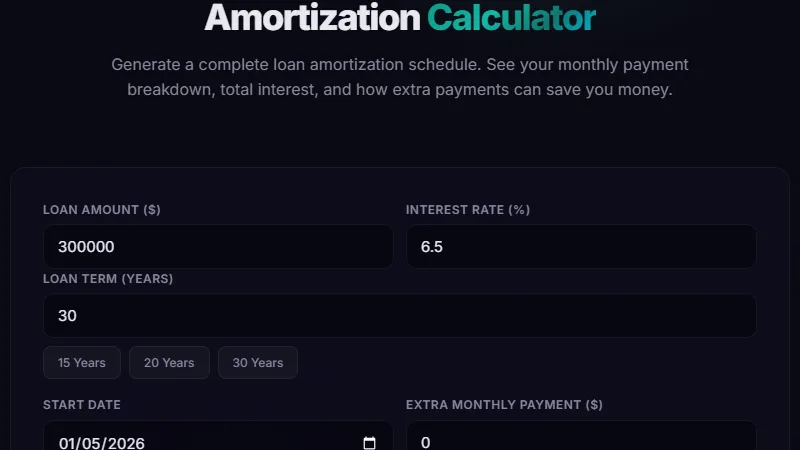
Enter the loan amount, annual interest rate, loan term, and optionally the start date and any extra monthly payment amount. The calculator generates a complete amortization schedule showing each payment's breakdown between principal and interest, the remaining balance after each payment, and the total interest paid over the life of the loan. The extra payment feature shows how additional amounts accelerate principal reduction.
Example Input
Loan amount: $300,000. Rate: 7%. Term: 30 years. Extra monthly payment: $200. The standard payment is $1,995. With the extra $200, the total payment is $2,195.
Output Comparison
Without extra payments: total interest over 30 years is $418,528. Total paid: $718,528. Loan paid off in 360 months.
With $200 extra monthly: total interest drops to $294,167. Total paid: $594,167. Loan paid off in 294 months (24.5 years). Savings: $124,361 in interest and 5.5 years of payments.
Biweekly Payment Strategy
Instead of 12 monthly payments per year, a biweekly schedule means you make 26 half-payments, which equals 13 full payments per year. This extra payment accelerates amortization without requiring you to find a large lump sum. Many lenders offer biweekly payment programs, though some charge a setup fee. The calculator shows the impact of biweekly versus monthly payments.
One-Time Lump Sum Payments
A lump sum payment, such as a tax refund or bonus, applied directly to principal provides an immediate reduction in the outstanding balance and saves all the future interest that would have accrued on that amount. For the $300,000 loan example, a single $5,000 lump sum payment in year one saves about $24,000 in interest and shortens the term by roughly 10 months.
Limitations to Keep in Mind
The calculator assumes a fixed interest rate and consistent extra payments. Variable-rate loans will have different amortization patterns. Some loans have prepayment penalties that reduce the benefit of extra payments. The calculator does not account for tax deductions on mortgage interest, which could reduce the effective cost of the loan. Extra payments should be applied to principal, not future payments, to realize the full benefit.
Frequently Asked Questions
Is it better to make extra principal payments or invest the money?
This depends on your interest rate and investment returns. If your mortgage rate is 7%, paying it down is equivalent to earning a risk-free 7% return. If you expect higher returns from investments, investing may be better. For most people, paying down high-rate debt provides guaranteed savings.
Do extra payments automatically go to principal?
Not always. You must specifically instruct your lender to apply extra payments to the principal balance. Otherwise, they may be applied to future payments or escrow. Always confirm the application method with your lender.
Can I make extra payments on any type of loan?
Most mortgages allow extra principal payments without penalty, but some loans have prepayment penalties. Check your loan documents. Car loans and personal loans may have different rules.
What is a good extra payment amount to start with?
Even $50 per month makes a difference. On a $300,000 30-year loan at 7%, $50 extra monthly saves about $38,000 in interest and pays off the loan 3 years early. Start with an amount that fits your budget.
Does refinancing reset the amortization schedule?
Yes, refinancing starts a new amortization schedule. If you have been paying on your current loan for several years, refinancing to a new 30-year term resets the clock and you begin paying mostly interest again. Consider a 15-year or 20-year refinance to avoid this.
When to Make Extra Payments and When Not To
Extra payments make sense when you have a high interest rate, a long loan term, stable employment, and an emergency fund already in place. They are less beneficial when you have high-interest credit card debt, lack an emergency fund, have a very low interest rate that is below expected investment returns, or are saving for a major purchase with higher priority. Use the calculator to model different scenarios and see the actual dollar savings before deciding.
Try the Amortization Calculator
Generate a full amortization schedule and see how extra payments save you money.
📊 Use the Calculator →