AI Token Costs — How to Estimate What Your Prompts Actually Cost
The Confusion It Clears Up
You paste a prompt into ChatGPT, GPT-4o, Claude, or Gemini and have no idea what it cost. The model returns an answer that's a few hundred words. Was that a fraction of a cent? A few cents? The pricing pages list dollars per million tokens, but that number is meaningless when you're looking at a single interaction. You need to convert "I typed 200 words and got 300 words back" into actual dollars — and compare the same prompt cost across different providers.
Token-based pricing is the standard across every major AI provider, but the rates vary wildly. GPT-4o charges $2.50 per million input tokens and $10 per million output tokens. Claude 3.5 Sonnet charges $3 per million input tokens and $15 per million output tokens. Gemini 1.5 Pro charges $3.50 per million input tokens and $10.50 per million output tokens. These numbers mean nothing until you translate them into your actual usage patterns.
The Real Scenario
A startup builds a customer support summarization tool. They process 10,000 conversations per day. Each conversation has an average of 1,500 words (about 2,000 tokens) and generates a summary of 200 words (about 267 tokens). At GPT-4o pricing, that's 10,000 x (2,000 x $2.50/1,000,000 + 267 x $10/1,000,000) = $76.70 per day — about $2,300 per month.
But they could use Claude 3.5 Haiku instead of Sonnet at $0.25 per million input tokens and $1.25 per million output tokens — dropping the same workload to about $7.67 per day ($230 per month). The AI token cost calculator shows these comparisons instantly. They decide to use Haiku for summarization and only route complex cases to Sonnet. Their blended cost stays under $500 per month while maintaining quality on the hard cases.
How the Calculator Works
Open the token cost calculator. You can either paste text directly (the tool counts its tokens) or enter estimated token counts. Select the provider and model you're evaluating. The tool breaks down the cost into input (your prompt) and output (the AI's response) components. You can also enter a monthly volume to see the projected monthly cost.
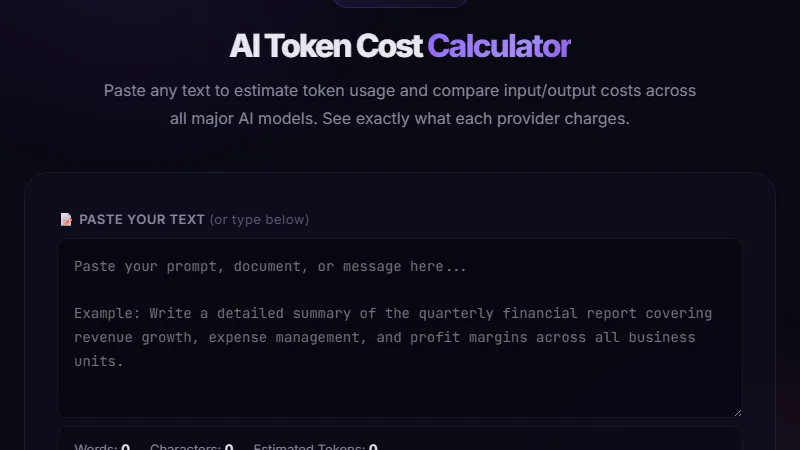
The tool supports side-by-side model comparison. Select two or three models and it shows a cost comparison table for the same input/output scenario. This is the most useful feature — it turns the abstract $/1M tokens numbers into concrete "this prompt costs $0.002 on GPT-4o vs $0.0003 on Claude Haiku" numbers you can use to make decisions.
GPT-4o: $0.0025 input + $0.0040 output = $0.0065 per request.
Claude 3.5 Sonnet: $0.0030 input + $0.0060 output = $0.0090 per request.
Gemini 1.5 Pro: $0.0035 input + $0.0042 output = $0.0077 per request.
At 100,000 requests/month: GPT-4o = $650, Sonnet = $900, Gemini Pro = $770.
Comparing Providers for a Large-Scale AI Feature
When building an AI-powered feature that will handle millions of requests, choosing the wrong model can cost tens of thousands of dollars per month. A company building an AI code review assistant estimates 500,000 requests per month with an average of 3,000 input tokens (the diff + context) and 500 output tokens (the review). The calculator shows: GPT-4o costs $6,250/month, Claude 3.5 Sonnet costs $8,250/month, and a fine-tuned Llama 3 hosted on their own infrastructure costs approximately $2,000/month in GPU time.
The calculator also helps with caching strategies. If 40% of requests are cacheable (identical diffs being re-reviewed), the effective cost drops proportionally. Toggle the cache ratio slider and the tool recalculates — showing that with 40% caching, GPT-4o drops to $3,750/month, making the managed API more competitive with self-hosting.
Limitations
The calculator uses average token-to-word ratios (approximately 1.33 tokens per English word for input, 1.5 tokens per word for output due to formatting tokens). These are estimates. Actual token counts vary by language, formatting, and model tokenizer. For precise counts, use the model's own tokenizer — the calculator gives you planning-grade estimates.
Pricing is based on published rates as of May 2026. AI model pricing changes frequently. The tool might not reflect the latest discounts, enterprise agreements, or spot pricing. Always verify against your provider's current pricing page before making financial decisions. The calculator also doesn't account for batch API discounts or committed-use discounts that some providers offer.
FAQ
How many tokens is my prompt likely to be?
As a rough rule: 1 token — 0.75 English words. A 1,000-word prompt is about 1,333 tokens. Code, lists, and structured data tend to tokenize less efficiently (more tokens per character). The calculator's paste-and-count feature gives an accurate count for your specific text.
Does the calculator include system prompts in the cost?
Yes. When you paste the full prompt (including system instructions, few-shot examples, and user input), the token count covers everything you send. System prompts are often 500-1,000 tokens themselves and add up over many requests.
Which model is cheapest for simple classification tasks?
GPT-4o mini ($0.15/1M input, $0.60/1M output) or Claude 3.5 Haiku ($0.25/1M input, $1.25/1M output) are the cheapest options from major providers. For high-volume classification, fine-tuned open-source models on your own hardware are cheaper but have higher upfront setup costs.
Does streaming affect cost?
No. Streaming or non-streaming, you pay for the same output tokens. The cost is determined by what the model generates, not how it's delivered. Streaming just improves perceived latency.
Should I include retries in my cost estimate?
Yes. If your application retries failed API calls, those add to the cost. Add a retry multiplier to your volume estimate. A 5% retry rate means multiplying your request count by 1.05. The calculator doesn't have a retry field, so adjust the monthly volume input manually.
Conclusion
Use the token cost calculator when evaluating AI providers for a new project, estimating a budget for an AI feature, or deciding whether to switch models. It turns the abstract per-million-token pricing into concrete per-request and per-month numbers that you can compare across providers.
Don't use it as a billing tracker — actual costs depend on exact token counts determined by the provider's tokenizer, not estimates. Also avoid it for fixed-price API plans or for models that charge by processing time rather than tokens. For those, check the provider's billing dashboard directly.
? Back to Blog