Exact Age — Beyond "How Old Am I" with Planetary Ages and Lifespan Context
What It Solves
The simple question "how old am I?" has a surprisingly complex answer. Your age in years on your birthday is easy, but what about between birthdays? Are you exactly 34 years old for a full year, or are you 34 years plus some months and days for most of that year? The tool gives you the precise answer down to the second: your exact age in years, months, days, hours, minutes, and seconds at the current moment. It also provides context beyond the number: your birth generation, zodiac sign, birthstone, and even your age on other planets. Knowing your exact age matters for medical calculations (drug dosages calibrated by age), legal documents requiring precise time since birth, and simple curiosity about the universe.
The Real Problem
Most people calculate their age by subtracting their birth year from the current year, then adjusting for whether their birthday has passed this year. That works for casual conversation but fails when precision matters. A doctor prescribing medication based on pediatric weight might need the patient's age in months, not years. A legal document might require exact age at the time of signing, down to the day. A competitive event might have age cutoffs that depend on the exact date. Even for personal milestones — how many seconds old were you when you got married? How many hours did you live before your first child was born? — the back-of-envelope calculation is error-prone.
The second dimension of the problem is context. "34 years old" tells you someone's chronological position but nothing about their generational cohort, astrological sign, or where they fall in the human lifespan. The tool adds these layers because age is more meaningful when you understand what it means in a broader context. A person born in 1992 is a Millennial, which tells you something about their cultural references and life stage. Someone born under Scorpio has an October-November birthday. Someone born in September has a sapphire birthstone. These details make the age calculation feel personal rather than mechanical.
How to Use It
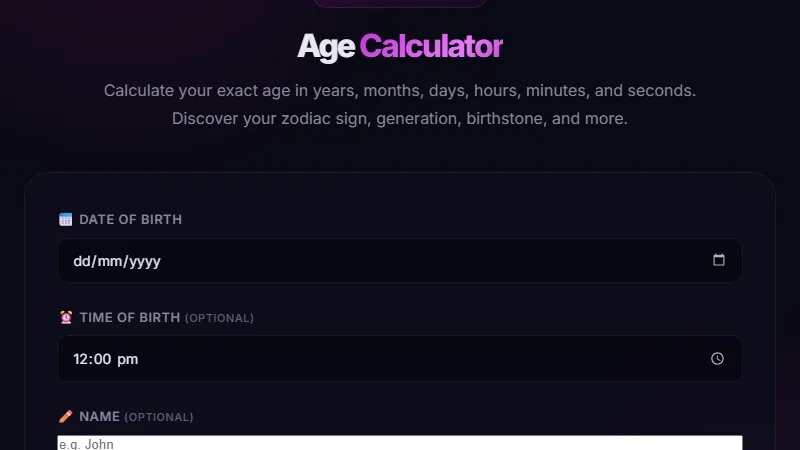
Enter your birth date — year, month, day, and optionally hour and minute for maximum precision. The tool calculates your age right now in every unit: years, months, days, hours, minutes, seconds. The display updates in real-time if you leave the page open (seconds tick up). Below the raw numbers, you'll find your generation (Silent, Boomer, Gen X, Millennial, Gen Z, Gen Alpha), your zodiac sign (Western), your birthstone, and the number of days until your next birthday. A special section shows your age on each planet in the solar system — how old would you be if you lived on Mercury, Venus, Mars, Jupiter, Saturn, Uranus, or Neptune, based on each planet's orbital period around the sun.
Exact age: 35 years, 11 months, 9 days, 19 hours, 30 minutes (and counting).
Generation: Millennial.
Zodiac: Gemini (May 21 - June 20).
Birthstone: Pearl or Alexandrite (June).
Age on Mercury: 149 Mercury years (88 Earth days per Mercury year).
Age on Jupiter: 3 Jupiter years (11.86 Earth years per Jupiter year).
The planetary ages provide a fun perspective — you've lived through 149 Mercury years but only 3 Jupiter years.
Medical and Legal Precision for Age Calculations
Age precision is critical in pediatric medicine. Drug dosages for children are often calculated per kilogram of body weight, but age in months determines which weight-per-age tables apply. A child who is 23 months old (1 year, 11 months) may be on a different dosage schedule than a child who is 25 months old (2 years, 1 month) because the metabolic changes between infancy and toddlerhood are significant. The tool's month-precision output eliminates the rounding error that occurs when someone says "about 2 years old." In legal contexts, age determination can affect contract validity, age of consent, guardianship decisions, and eligibility for benefits. A person who is 17 years, 364 days old cannot sign a binding contract in most jurisdictions. The tool's day-level precision ensures you know exactly where you stand legally. For wills or trusts that distribute assets at specific ages ("when the beneficiary reaches 25"), the exact date calculation confirms that the milestone has been reached.
Birthday Countdown and Life Stage Awareness
The days-until-next-birthday counter is more useful than it seems. For parents tracking a child's first-year milestones, knowing there are 47 days until the first birthday helps plan parties, medical appointments, and developmental check-ins. For adults, the countdown builds anticipation. Beyond the countdown, the life stage context helps you understand where you are in the average human lifespan. The average global life expectancy is about 73 years. If you're 35, you've lived roughly 48% of your expected life. If you're 50, you're at 68%. This isn't morbid — it's practical for retirement planning, health screening schedules (mammograms start at 40, colonoscopies at 45), and life insurance purchasing. The tool shows your estimated remaining years based on general life expectancy data, with a note that individual factors vary widely.
Limitations
The tool calculates age based on the Gregorian calendar. If you were born in a country that uses a different calendar system (like the Hijri calendar), your birth date converted to Gregorian may not match your traditional birth date. The planetary ages use each planet's sidereal orbital period (time to orbit the sun), which is an astronomical approximation. The tool rounds planetary ages to two decimal places. The generation labels are based on common ranges but boundaries vary by source — PEW Research uses slightly different cutoffs than other demographers. The zodiac uses Western tropical astrology; Vedic (sidereal) astrology will produce different signs. The life expectancy estimate uses global averages and is not personalized. The tool does not account for time zones — the age is calculated based on your current local time as set in your browser or device.
FAQ
How is an "exact age" different from a regular age?
A regular age counts only the number of full years since birth. An exact age includes the years plus the remaining months, days, hours, minutes, and seconds. When someone asks "how old are you?" they expect the whole number. When a medical form asks for "age in months," they need the exact remainder.
How are planetary ages calculated?
Your age in Earth years is divided by each planet's orbital period (sidereal year). Mercury orbits in 87.97 Earth days (0.241 Earth years), so your age in Mercury years = Earth age / 0.241. Jupiter takes 11.86 Earth years per orbit, so your Jupiter age = Earth age / 11.86. The results show how many times each planet has orbited the sun since your birth.
What generation am I based on my birth year?
Common ranges: Gen Alpha (2013+), Gen Z (1997-2012), Millennial (1981-1996), Gen X (1965-1980), Boomer (1946-1964), Silent (1928-1945). These vary slightly between sources. The tool uses the most commonly accepted ranges from demographers like Pew Research and McCrindle.
Does the tool account for leap seconds or DST?
No — leap seconds (added to UTC occasionally since 1972) are not included because they affect only extremely precise scientific timing. Daylight saving time is not applied because it's a local civil time convention that doesn't change the actual elapsed time since your birth. The calculation uses your browser's local time without DST adjustment logic.
Can I calculate someone else's age with this tool?
Yes — enter any birth date (with optional time) and the tool calculates the exact age as of now. You can use it for family members, historical figures, or fictional characters. The generation, zodiac, and planetary sections are based on the birth date entered, so they will update accordingly.
Conclusion
Use this tool when you need precise age down to seconds for medical, legal, or personal milestones. It's most valuable when the difference between "almost 18" and "exactly 18" matters — legal signings, competition eligibility, medication dosing. It's also great for fun: planetary ages, next-birthday countdowns, and generational context add depth to what would otherwise be a simple number. Don't use it for financial age calculations that require actuary tables (retirement calculators handle that separately) or for determining exact time zones across different birth and current locations. The tool assumes you want your age as of right now in your current location. For static historical age calculations (age at a specific past date), use the date difference calculator instead.
For related timing needs, the time duration calculator handles precise time-between-two-points calculations, and the date difference calculator provides day-level precision for any two dates in history.
← Back to Blog